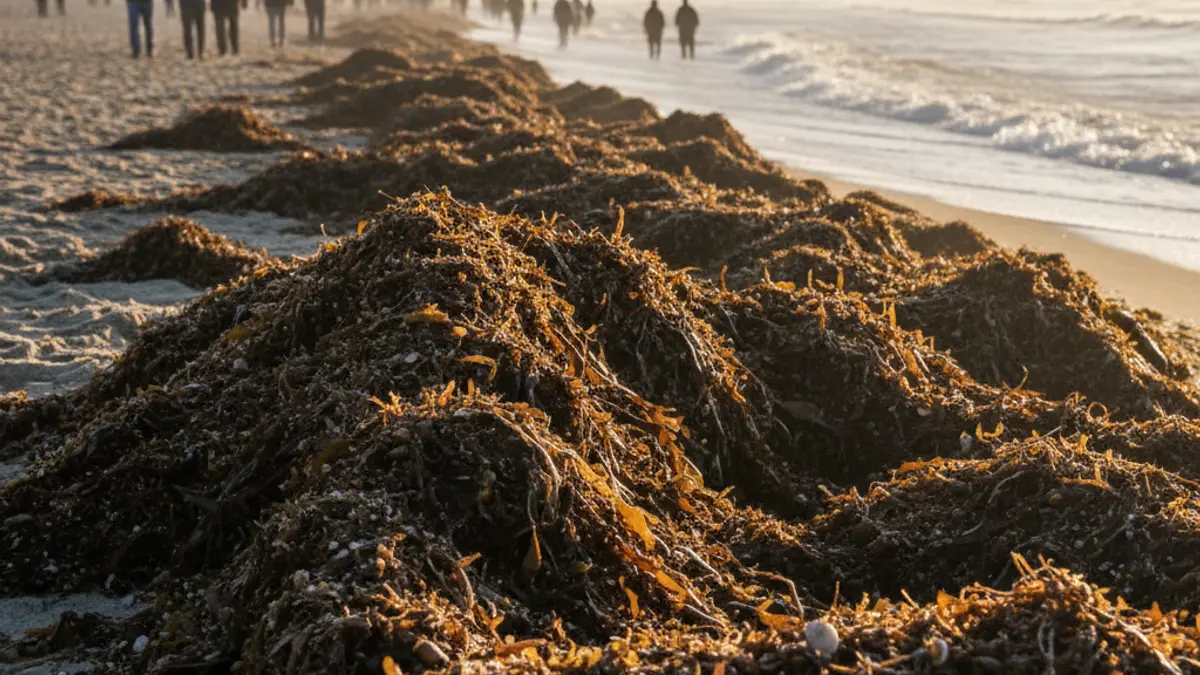
Ten years after its appearance in Andalusian waters, Rugulopteryx okamurae continues to spread without experts seeing a real possibility of eradication. The province of Málaga is emerging as the second most affected in Andalucía by this species.
The impact of this algae will be felt across a large part of the Málaga coastline, including municipalities such as Manilva, Casares, Estepona, Marbella, Mijas, Fuengirola, Benalmádena, Torremolinos, Málaga capital, Rincón de la Victoria, Vélez-Málaga, Torrox, and Nerja. Although significant episodes are expected, their consistency might be less than in other areas of the Andalusian coast.
“"It is capable of growing very fast."
The spread of this species, which dates back a decade, is attributed to the illegal discharge of ballast water from commercial ships, according to a study by researchers Rubén Vázquez and Salvador Román. The situation has consolidated into a major environmental problem, described by experts as “uncontrollable” and “not eradicable”.
Regionally, the Junta de Andalucía's projections for 2026 estimate the arrival of 49,000 tons of algae, with a scenario that could reach 64,000 tons. The province of Cádiz will be the most affected, especially in the Campo de Gibraltar, Barbate, and the Bay of Cádiz, followed by Málaga in estimated volume.
The presence of Rugulopteryx okamurae not only displaces native algae and alters the trophic chain, but its accumulation and decomposition also degrade water quality and reduce oxygen levels. This creates serious problems for the fishing sector, which has reported catch declines of between 20% and 48% in thirteen species, according to data from the Ministry for Ecological Transition.
The algae gets entangled in nets, overloads fishing gear, and forces fishermen to spend more time cleaning, affecting methods such as small-scale fishing, bottom longlining, trammel nets, and purse seines. The Ministry for Ecological Transition and Demographic Challenge already classified it in 2020 as a high-risk invasive species, noting its impact on marine habitats, biodiversity, and protected areas of the Natura 2000 Network, in addition to the removal costs for administrations.