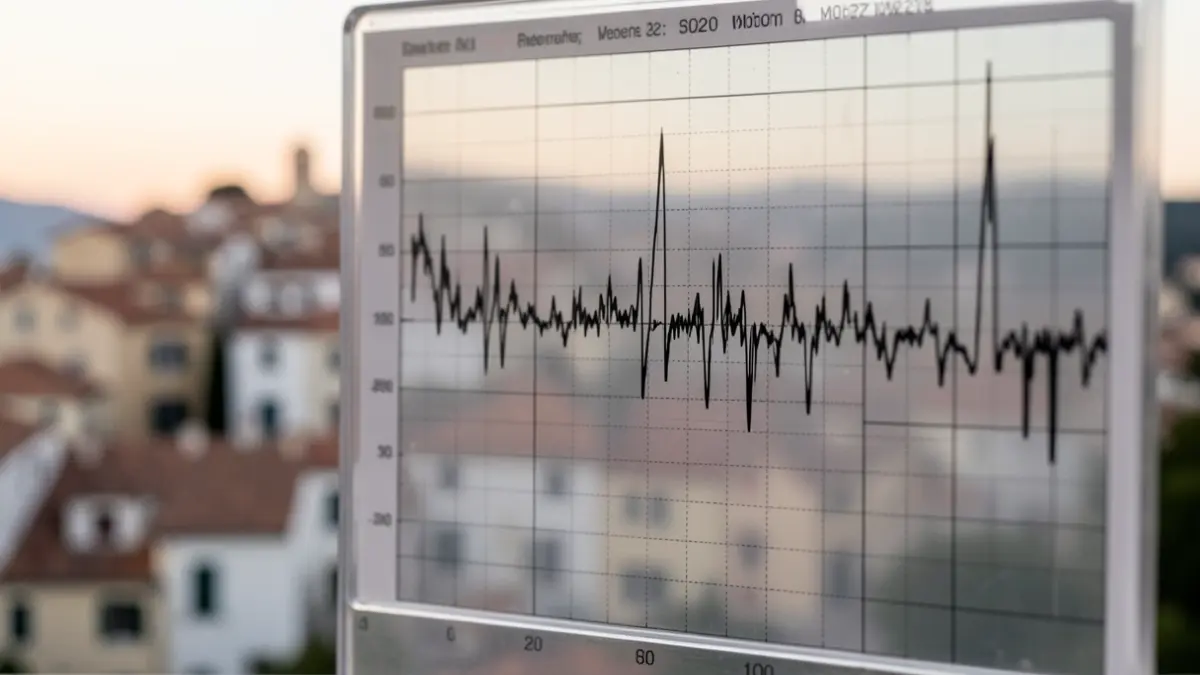
Seismic activity in the province of Granada continued during the early hours of Friday, although with a trend towards slowing down in terms of number and intensity of movements. In a period of just under two and a half hours, seven new earthquakes were recorded, all located in municipalities within the Metropolitan Area.
The National Geographic Institute (IGN) has located the epicenters of these tremors in towns such as Armilla, Alhendín, La Zubia, Ogíjares, Churriana de la Vega, and Gójar. These low-magnitude movements are part of the seismic swarm that has been affecting the Vega de Granada for a week.
The strongest tremor of the night occurred at 5:44 AM, with a magnitude of 2.4 and an epicenter east of Ogíjares. The IGN locates it at a depth of zero kilometers and confirms it was felt by the population. Previously, at 4:05 AM, another earthquake of magnitude 2.2 with an epicenter west of Armilla, also of shallow depth, was similarly perceived.
Seismic activity began earlier, at 3:54 AM, with a first tremor of magnitude 1.6 in Armilla. Later, at 4:31 AM, Alhendín registered a movement of magnitude 1.9. Before the strongest tremor in Ogíjares, at 5:16 AM, La Zubia experienced a tremor of 1.7 at a depth of four kilometers.
The movements continued until close to dawn. At 6:11 AM, Churriana de la Vega recorded an earthquake of magnitude 1.8 at zero kilometers depth, followed by another in Gójar at 6:13 AM, with a magnitude of 1.6 and at a depth of four kilometers. Neither of these last two were marked as felt in the official list.
These new records add to the sequence initiated on August 14, which included a magnitude 5 earthquake with an epicenter in Alhendín. According to the latest report from the IGN, the series had already accumulated 621 events, most of magnitude 2 or less, with over 40 felt by the population and about ten reaching magnitude 3 or higher.
The earthquakes this morning follow the pattern of recent days, characterized by shallow movements and dispersed epicenters across the metropolitan belt, although with considerably lower magnitudes than those that caused the main shocks of the week.