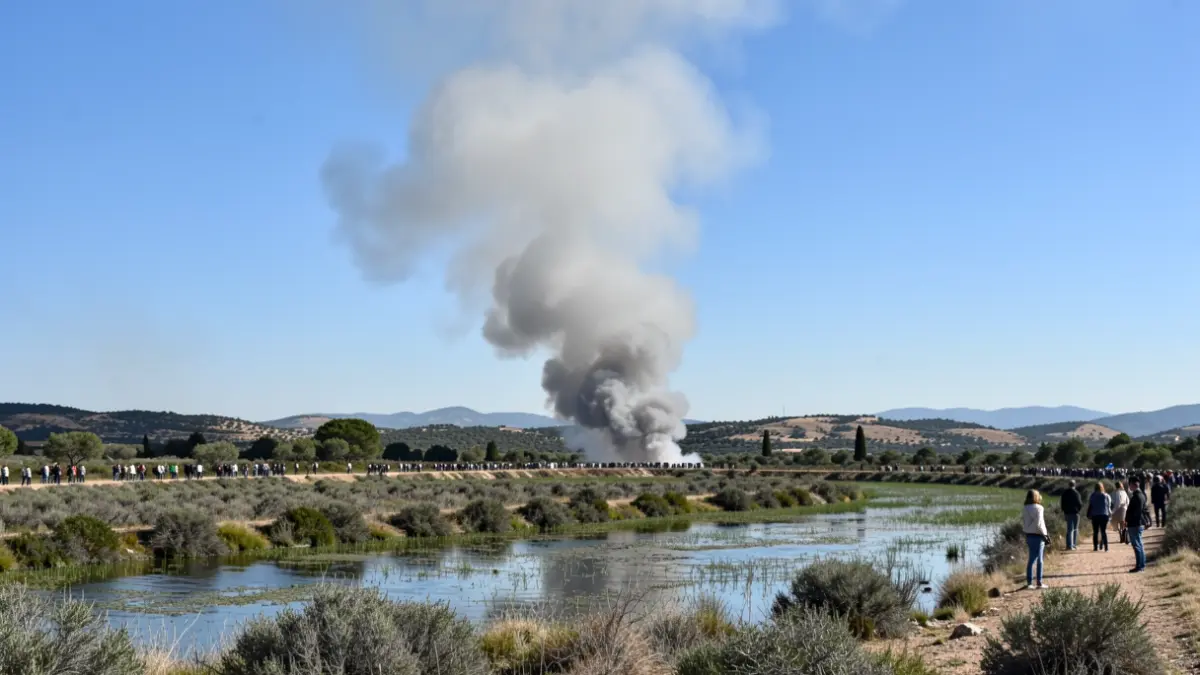
The fire that broke out last Sunday in the Marismas del Burro area, within the protected Marismas del Odiel in Huelva, is producing a large amount of smoke that experts describe as 'dangerous' to human health. Two professors from the University of Huelva, Jesús de la Rosa (Doctor of Geological Sciences and air quality expert) and José Prenda (Zoology department), have expressed concern over the pollutant particles inhaled in the city.
Jesús de la Rosa stated that very high concentrations of fine (PM2.5) and ultrafine (PM1 and PM01) particles were detected in neighborhoods such as La Orden, La Cinta, La Barriada del Carmen, Cárdenas, Santa Marta, and along Avenida de Andalucía and the Campus del Carmen. Pollution peaks, which far exceeded the levels recommended by the WHO (World Health Organization), were recorded between 3 PM and 5 PM on Tuesday and again between 11 PM and 4 AM on Wednesday, reaching up to 500 micrograms per cubic meter in some areas.
“"What is important, especially for people with health problems, is to self-isolate, not to go out, to close windows as much as possible, even if the air is already stale, and, if necessary, to use FFP2 masks like those we used during the pandemic. Likewise, the recommendation is that during recess, 'children should not play sports'."
Given this situation, the public, especially those with health issues, are advised to stay indoors, close windows, and use FFP2 masks if necessary. It is also recommended that children refrain from physical activity during recess. De la Rosa also mentioned the difficulty in controlling the fire due to the presence of peat in the marshland, which causes deep combustion and the potential for new outbreaks.
For his part, José Prenda highlighted the 'maximum ecological value' of the Marismas del Odiel, recognized as a Biosphere Reserve, Ramsar site, and Site of Community Importance. He explained that the affected area, Marismas del Burro, is a crucial nucleus for species conservation, particularly birds, many of which nest on the ground and are directly impacted by the fire. The smoke plume, besides being a nuisance to humans, also scares away wildlife, preventing them from feeding.
A marshland is not a place where fire can have beneficial effects in any case from the perspective of conservation and from the perspective of the natural values of a site.
Prenda concluded that, unlike other ecosystems, fire does not bring benefits to marshlands from a conservation or natural value standpoint, especially during the breeding season.