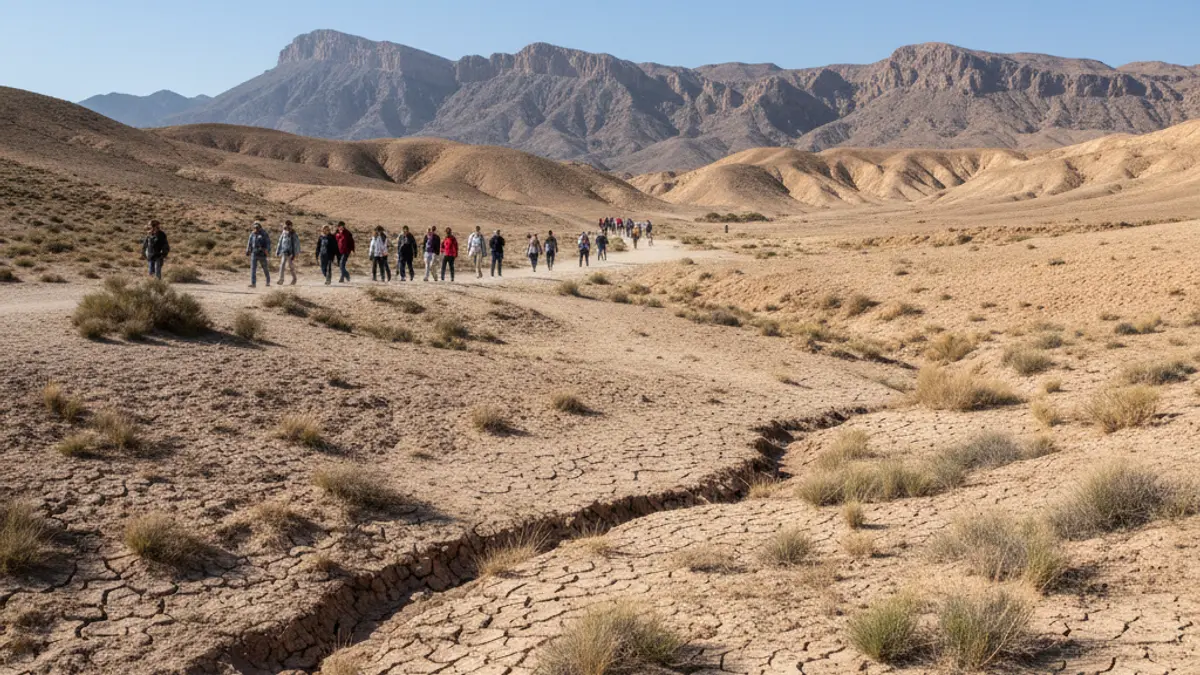
Wildlife in the province of Almería is experiencing an alarming loss of space, particularly in the Tabernas region. A study conducted by the CSIC reveals that animals have less territory to live in and face greater difficulties moving through their natural environment.
A clear example of this situation is the pin-tailed sandgrouse, a bird that lives in open areas and requires large, continuous spaces. In Tabernas, this species could lose up to 35% of its habitat, and over 40% in the highest quality areas, which are crucial for its feeding and reproduction.
In addition to habitat reduction, the territory is becoming increasingly fragmented. Ecological connectivity, which facilitates animal movement between different points, has decreased by 15.67% in Tabernas and could reach 31% if planned projects are carried out. This implies an increase in obstacles and a reduction in natural corridors for wildlife.
The problem does not only affect the pin-tailed sandgrouse. Other birds such as the little bustard, the Dupont's lark, the stone-curlew, and the trumpeter finch, which also reside in this environment, depend on open and continuous landscapes. The reduction and fragmentation of these lands negatively impact all these species. Even the plant Linaria nigricans, an essential part of the ecosystem, could lose up to 23% of its quality habitat, affecting the species that depend on it.
The study identifies several factors contributing to this situation, such as the construction of roads, solar and wind farms, agricultural exploitations, and urban growth. These elements introduce barriers into the territory, with the N-340a area being a critical point where there is a risk of a continuous urbanized strip forming between Tabernas and Cañada de Miralles, eliminating vital spaces for wildlife.
The report emphasizes that this is not an isolated problem, but rather the accumulation of various impacts. Habitat loss, disturbances generated by human activity, and changes in the landscape are creating a combined effect on wildlife. This process is already underway in Tabernas, altering the natural balance of the ecosystem.