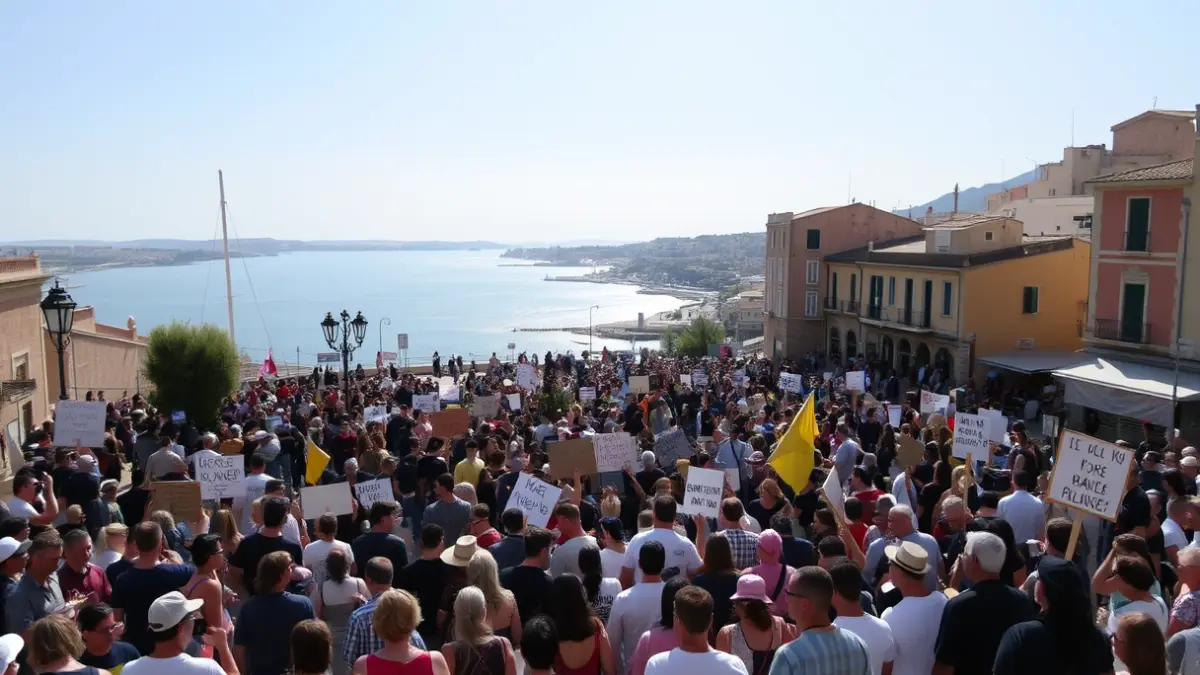
Various organizations, including fishermen's guilds, merchant associations, and environmental groups, have called for a march in Sanlúcar de Barrameda. The protest, starting from Bajo de Guía, seeks to halt what they consider an unprecedented threat to the region, linked to discharges from the Aznalcóllar and Gerena mines.
The reopening of the Aznalcóllar mine, with a significantly larger exploitation volume, and the activity of the Gerena mine, just ten kilometers away, have raised alarms in the Guadalquivir basin. The extraction of 76 million tons of mineral is planned over the next 17 years, but the main concern is that the waste pond will be the Guadalquivir riverbed itself.
According to the convening groups, the project involves discharging up to 120 billion liters of water near Seville capital over 18 years. A particularly critical phase is the preliminary one, where 17.5 billion liters will be released at once to empty contaminated waters from the Aznalcóllar and Los Frailes mine pits during the first year and a half.
Scientists from the universities of Seville, Cádiz, and Granada have documented high levels of heavy metal contamination in the sediments of the Lower Guadalquivir, accumulated between 2009 and 2023. The impact on fauna is notable, with one-third of fish like mullets showing lead concentrations exceeding legal limits for consumption.
“"Environmental impact studies validated by the Junta de Andalucía have been labeled a "fraud" by experts, who warn that heavy metals adhere to river mud particles and bioaccumulate in living beings, rather than dissolving into the ocean."
Although the water to be discharged will undergo a purification process, scientists warn about the massive and persistent amount of heavy metals that will reach the riverbed, including 5,000 kg of arsenic, 3,000 kg of lead, 700 kg of cadmium, and 400 kg of mercury. This situation threatens thousands of jobs in fishing, agriculture, and tourism, as well as the health of riverside populations.
Given the lack of response from authorities, the organizers demand an immediate moratorium on new discharges and the establishment of an independent committee of scientific experts. The goal is to rigorously assess the real impact of mining projects before an irreversible catastrophe occurs in the Guadalquivir estuary.