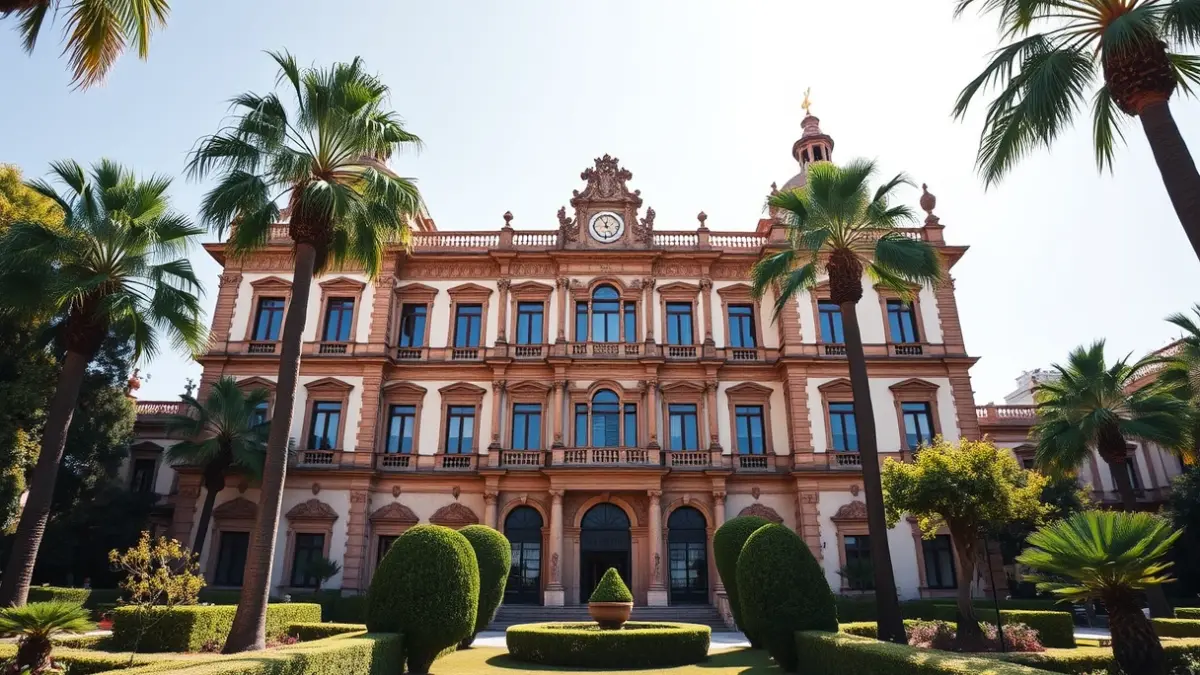
Located on Avenida Manuel Siurot, Villa Luisa Palace is one of Seville's most impressive and lesser-known palace houses. Its construction, finished in 1925, was part of the context of the Ibero-American Exposition of 1929, with the vision of becoming a meeting point for prominent cultural figures in the early 20th century.
The building was commissioned by a classical composer and patron of artists, who wished for his home to be a center for the cultural personalities of the era. Born in Paris in 1859, this musician trained at the National Conservatory of Music and Dance, specializing in Composition and Piano under renowned masters.
After achieving early success, he settled in Seville in 1918. With the collaboration of Valencian architect Vicente Traver y Tomás and artisans from Seville, Granada, and Morocco, a residence was built that evoked a cinematic atmosphere. The property was named “Villa Luisa” in honor of the founder's mother, becoming his habitual residence and a venue for memorable celebrations.
After the founder's death in 1931, his family decided to open the house to the public years later. The property, which had belonged to a music lover, could not remain closed. Thus, Villa Luisa transformed into a space for celebrations, beginning a new chapter that was consolidated in 2016 after an extensive restoration completed in 2020.
The palace's corners reflect the rich symbolism of its constituent styles, offering an inexhaustible source of artistic inspiration. It has been the setting for productions such as the series La Peste, filmings like the Scuola di Danza Mirko Vullo, and various commercials. Currently, Villa Luisa is a venue for social and corporate events, featuring beautiful halls such as the Patio de las Columnas, the Salón de los Leones, the Salón de los Tapices, the Salón Escondido, and the Salón de Conferencias. Its magical gardens, spanning over 4,400 square meters and boasting nearly 80 monumental palm trees, make it a unique enclave in the heart of the city.