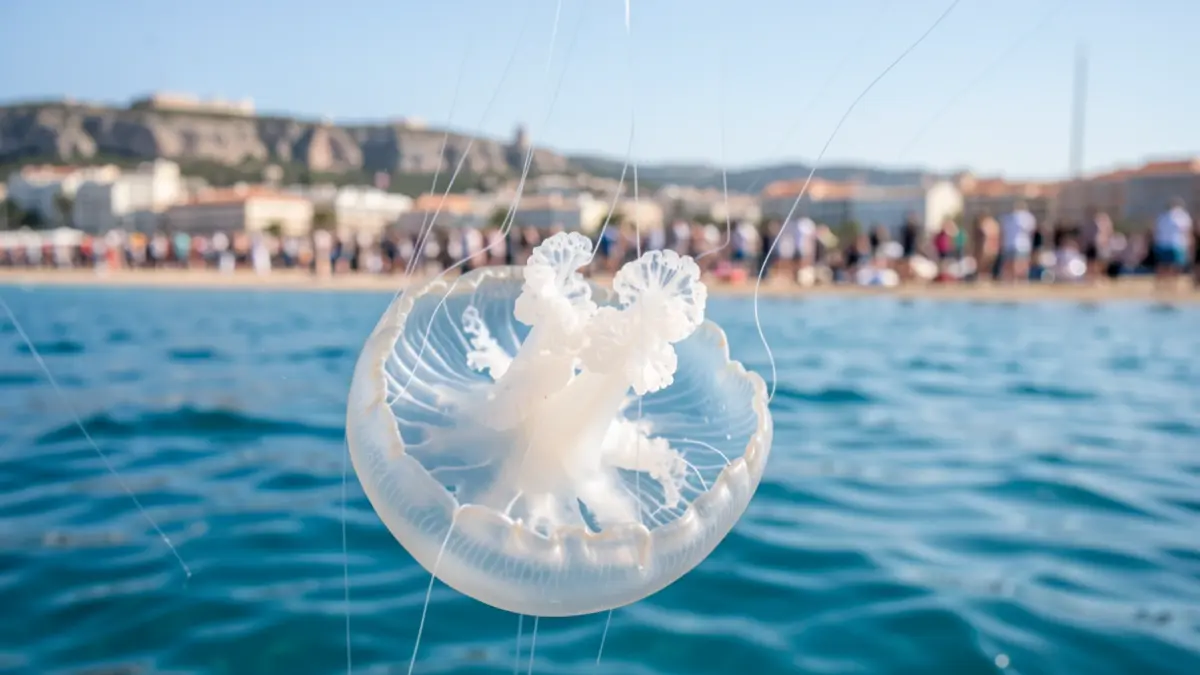
Summer is nearing its midpoint without jellyfish bothering swimmers on Malaga's beaches. Experts, such as Jesús Bellido, a biologist at Aula del Mar, are optimistic, stating that a difficult month in August is not anticipated. The absence of large swarms near the coast, even with easterly winds that typically attract them, suggests a tranquil scenario.
Francisco Franco, director of the Coastal Sciences Chair Costa del Sol, explains that while there are many jellyfish in the open sea, the currents in the Alboran Sea are blocking their entry to the coast. These animals move with the tides, and their arrival at beaches depends directly on the currents, which this year are marked by the powerful "Atlantic jet" forming two main gyres off Calaburras (between Fuengirola and Mijas) and in the Motril area.
These gyres act as water whirlpools that keep jellyfish, particularly the Pelagia Noctiluca species, away from the province's beaches. Only when these gyres dissipate do the invertebrates have a chance to reach the coast. Currently, both gyres are well-established, preventing the arrival of large jellyfish blooms since the beginning of summer.
Franco notes that these ocean gyres typically open up after rainy springs, but this year, despite a wet winter, the spring was dry. This has contributed to the gyres remaining closed, allowing for a summer without the usual jellyfish presence. A change in weather conditions, such as the arrival of storm fronts, could alter this situation, though it is considered unlikely in August.
Once past the natural barrier of the currents, winds play a role in bringing jellyfish closer to or further from the shore. Bellido recalls that jellyfish presence on Malaga's beaches has been scarce in recent years, with sporadic and not continuous episodes, unlike in 2018, which was the worst-case scenario recorded.
For jellyfish monitoring on the Costa del Sol, the Aula del Mar's Infomedusas app is not active this year. The role has been taken over by Oceanaria, a tool developed by the R&D Edanya research group and the Coastal Sciences Chair of the UMA, which uses artificial intelligence to predict jellyfish arrivals at the province's beaches five days in advance. Current possibilities do not exceed 20%.