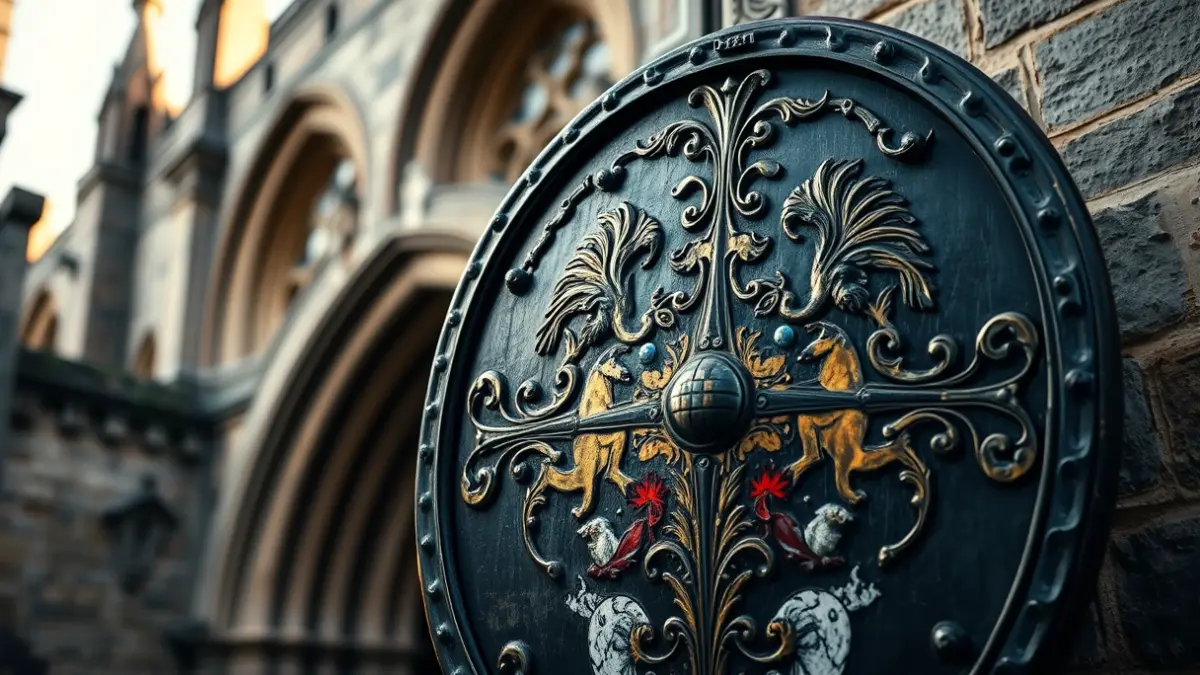
These monumental heraldic shields, measuring over two and a half meters in height, are found on the transept wall: one in the north wing, near the Chains Gate, and the other in the south wing, at the Sun Gate. Both are positioned above superb noble wood choir stalls from the 18th century, requiring visitors to look up to appreciate them.
The emblems reflect the ambitious marital policy of Ferdinand V of Aragon, known as the Catholic, whose objective was to isolate France and consolidate the unification of the Iberian Peninsula. When Philip II ascended to the throne in 1556, he inherited a vast and complex territory, whose royal arms were faithfully represented by the official Kings of Arms and heralds of the era.
The polychrome armory, framed within a large masonry circle, includes a black eagle with spread wings and golden talons, supporting the lower part of the structure. From this hangs the Grand Collar of the Order of the Golden Fleece, and the ensemble is topped by an open gold crown adorned with jewels. Two golden lion heads emerge from the top, on either side of the head of Saint John's eagle, the device of Queen Isabella the Catholic.
The Andalusian Institute of Historical Heritage considers these works anonymous. However, research suggests that the Italian artist César Arbassia, a specialist in painting and gilding, may have initiated the work on these shields during the cathedral's renovations in the 16th century, under the mandate of Bishop Francisco Pacheco y Córdoba (1575-1587).
A notable feature is a heraldic anomaly in one of the quarters, belonging to Modern Austria, which displays a golden ark with an open lid and three logs at its base. This figure is believed to symbolize the Ark of the Covenant from the Old Testament, an unusual addition that has gone unnoticed and could represent a concession from the Cathedral's iconographic program or Bishop Pacheco Córdoba himself to sacralize the Royal Patronage.