The University of Huelva is spearheading a new research line that merges experimental nuclear physics, electronics, and artificial intelligence to tackle a critical challenge in large scientific experiments: the precise identification of particles generated during nuclear reactions. The LORRAINE project (‘Low Energy Particle Identification using Neural Networks’) focuses on developing advanced algorithms based on neural networks to optimize the analysis of low-energy particles.
This three-year project involves researchers such as José Antonio Dueñas Díaz, Professor of Electrical Engineering and project lead, Patricio Salmerón, Professor of Electrical Engineering, and Juan Luis Flores, collaborating professor. Their objective is to combine traditional signal analysis methods with state-of-the-art machine learning techniques to enhance particle identification capabilities in international experiments.
Nuclear reactions, produced by colliding accelerated particles with materials, generate fragments detected by sophisticated electronic systems. The information from these electrical signals reveals each particle's nature, energy, and mass. However, low-energy particles emit weaker, more difficult-to-interpret signals, according to the principal investigator.
Dueñas explains that the work involves identifying particles through the electrical signals they generate upon hitting a silicon detector, with the main challenge being the correct interpretation of these signals. Traditionally, complex mathematical algorithms were used, but the increasing complexity of experiments and new detection technologies have driven the search for more efficient solutions.
The LORRAINE project embraces artificial intelligence, specifically deep neural networks (Deep Neural Networks), which learn to recognize complex patterns, thereby improving analysis speed and accuracy. These neural networks, inspired by the human brain, can distinguish similar signals after training and process vast amounts of data in real-time, which is crucial in scientific facilities generating millions of events.
The developments from the University of Huelva are applied to data from international infrastructures such as CERN, GANIL in France, the National Laboratories of Legnaro in Italy, and the TRIUMF accelerator in Canada. The project is integrated into the international collaboration ACTAR, focused on instrumentation for nuclear physics.
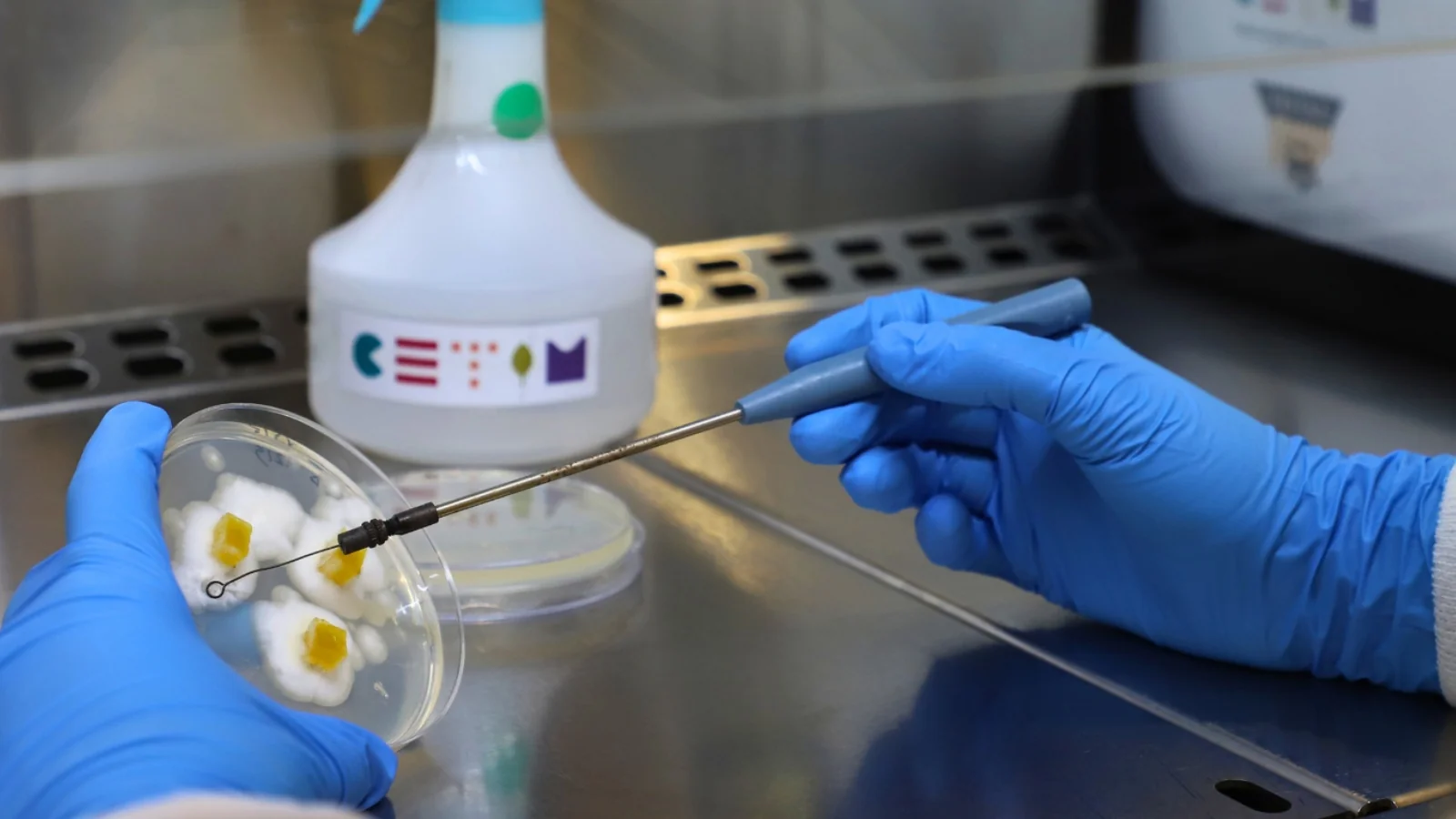
UHU's contribution encompasses algorithm development and the characterization of silicon detectors and other scientific instrumentation devices. The team provides specialized knowledge, research personnel, and instrumentation to characterize detectors before their use in particle accelerators, and subsequently analyzes experimental data to improve particle identification.
Although it is basic research, its findings have significant potential for transfer to other scientific and technological fields. More precise particle identification could drive advancements in nuclear medicine (such as PET-CT scans, dosimetry, or proton therapy), materials science, or energy research. Dueñas emphasizes that this knowledge is applicable across numerous domains.
Beyond scientific advancement, the project serves as an important training tool for students and researchers at UHU, offering opportunities to participate in laboratory work, develop final degree and master projects, and, in some cases, collaborate in experimental campaigns at major international laboratories.
The LORRAINE project aligns with a growing trend in experimental physics: the incorporation of artificial intelligence as a support tool for scientific data analysis. While not replacing experimental instrumentation, these technologies are transforming how researchers interpret the enormous amount of information generated by particle accelerators.
José Antonio Dueñas concludes that artificial intelligence will not change laboratories themselves but is revolutionizing data analysis, marking the beginning of a transformation with a significant impact in the coming years.