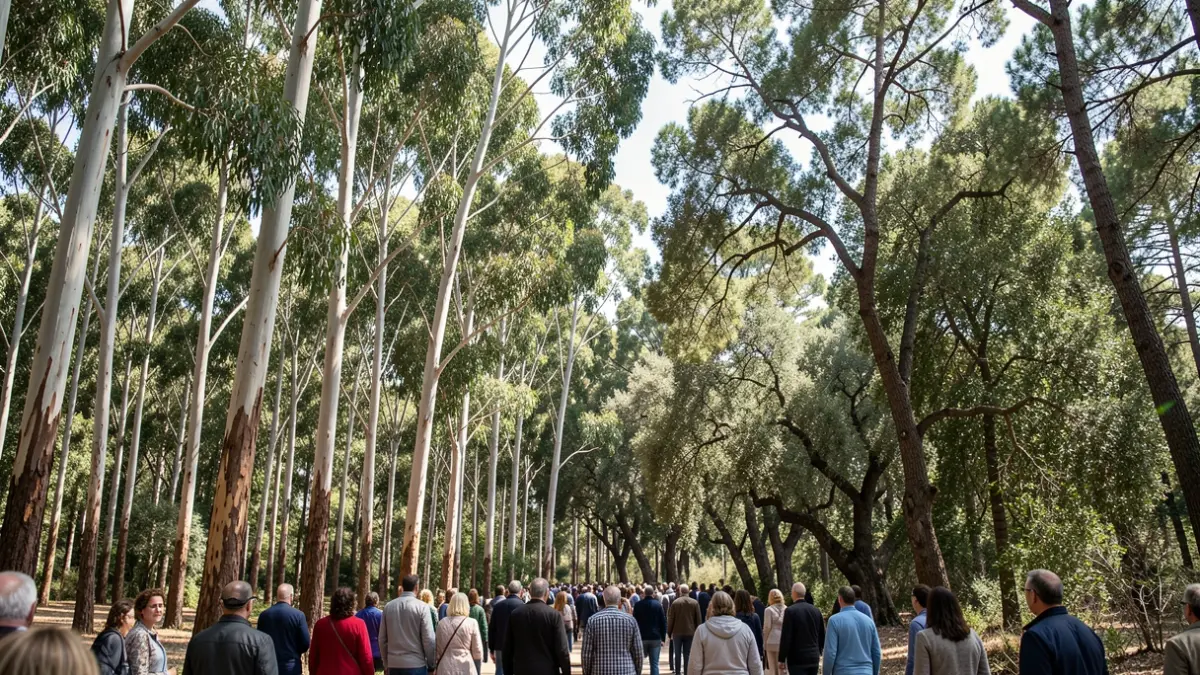
The autonomous community of Andalusia has undertaken a significant reduction in the area covered by eucalyptus trees, eliminating more than 117,269 hectares over the past four decades. This initiative primarily aims to mitigate the risk of forest fires, as eucalyptus is considered more prone to fire spread, while simultaneously promoting the recovery of the Mediterranean forest and native species diversity.
According to data from the Andalusian Regional Ministry of Sustainability and Environment, the current area of eucalyptus plantations is around 150,000 hectares, a considerable decrease from the approximately 267,269 hectares recorded about forty years ago. The province of Huelva stands out, leading this reduction with a decrease of 63,700 hectares of eucalyptus.
This substitution policy gains particular relevance given the intense fire season currently affecting Andalusia, especially Huelva. The Andalusian government has reaffirmed its commitment to continue with the Andalusian Forest Plan and its Horizon 2030 Adequacy, which includes the progressive reduction of eucalyptus and the promotion of native species.
The President of the Regional Government, Juanma Moreno, has emphasized the objective of "gradually recovering the Andalusian Mediterranean forest," "protecting biodiversity," and strengthening the resilience of ecosystems against climate change. During a visit to a command post in Niebla (Huelva) due to a fire, he compared eucalyptus resin to "gasoline" for its contribution to fire spread.
The recovery of 84,300 hectares of eucalyptus plantations with low ecological suitability is underway, as seen in Doñana, where the goal is to restore species native to the sandy landscape. In public forests of Huelva and Sevilla, eucalyptus have already been replaced by mixed formations of conifers and broadleaf trees, including holm oaks, cork oaks, and pines, which are emblematic of the Andalusian Mediterranean landscape.
The strategy does not involve the complete eradication of eucalyptus but rather the substitution of those stands with lower ecological value for native species that are more resistant to erosion and drought. The aim is also to create a more diverse vegetation mosaic to reduce fuel continuity and hinder the spread of forest fires.
This strategy is complemented by promoting extensive livestock farming to control undergrowth and the sustainable use of timber. Eucalyptus plantations with a productive function will be maintained, but their presence will be limited to land with greater suitability for this use, while in protected areas, the focus will be on conserving the native Andalusian forest.