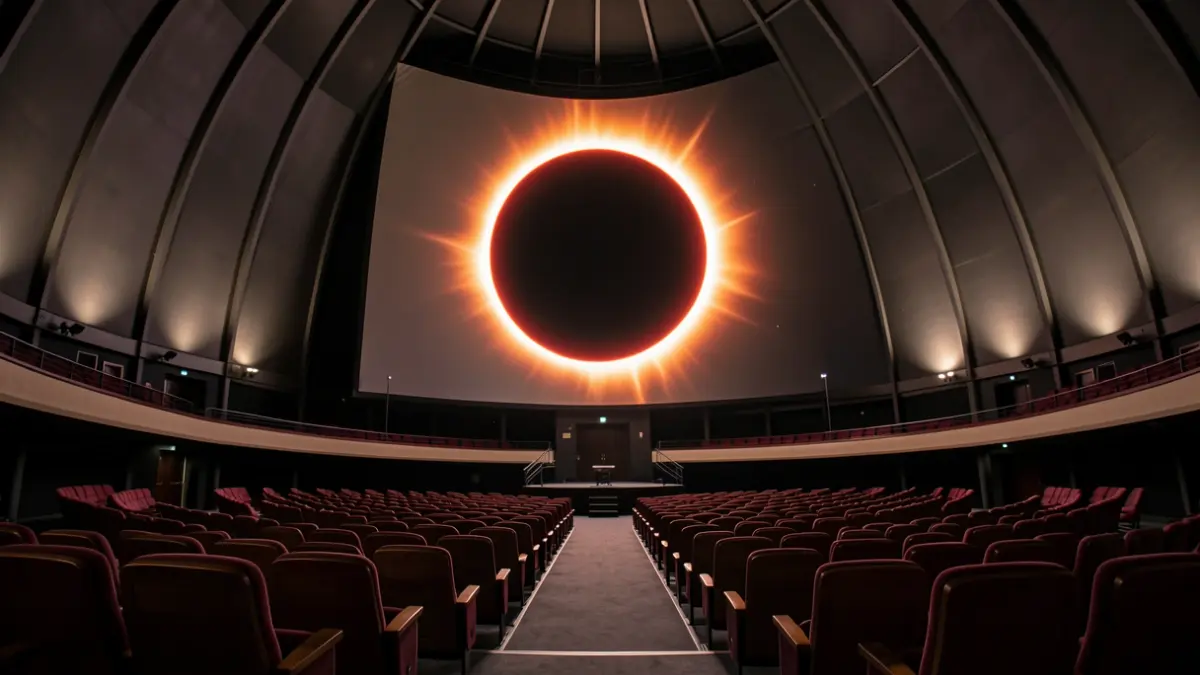
The 3CLIPSE program, which can be seen in the park's Planetarium until January 2028, has been created by various scientific institutions to explain one of the most extraordinary astronomical phenomena of the coming decades. The eclipses in 2026 and 2027 will be total, and the one in 2028 annular, making the Iberian Peninsula a key point for astronomical observation.
Driven by the Elder Museum of Science and Technology of Las Palmas de Gran Canaria and directed by astrophysicist Fernando Jáuregui, the documentary explores the origin of eclipses, their cultural significance throughout history, and the fascination they continue to generate today. The production combines scientific outreach, visual narrative, and emotion, following the story of a girl and her grandmother.
This scientific outreach project, with the collaboration of the Spanish Foundation for Science and Technology (FECYT) and the Ministry of Science, Innovation and Universities, involves institutions from Spain and Portugal. The director of the Science Park, Alfonso Peres, highlighted that this initiative reinforces the center's commitment to promoting astronomy and teaching safe methods for observing and recording these phenomena.
In addition to the screening, the Science Park offers complementary educational resources on its website, such as a downloadable exhibition, didactic guides, and videos. On the occasion of the 'Iberian Trio of Solar Eclipses', the park has organized a program of outreach and training activities during 2026, including informational talks and safe observation sessions.
On August 12, the Science Park will follow the broadcast of the solar eclipse organized by the European Space Agency (ESA) from the Javalambre Observatory in Teruel, with broadcast alternatives in case of adverse weather conditions.