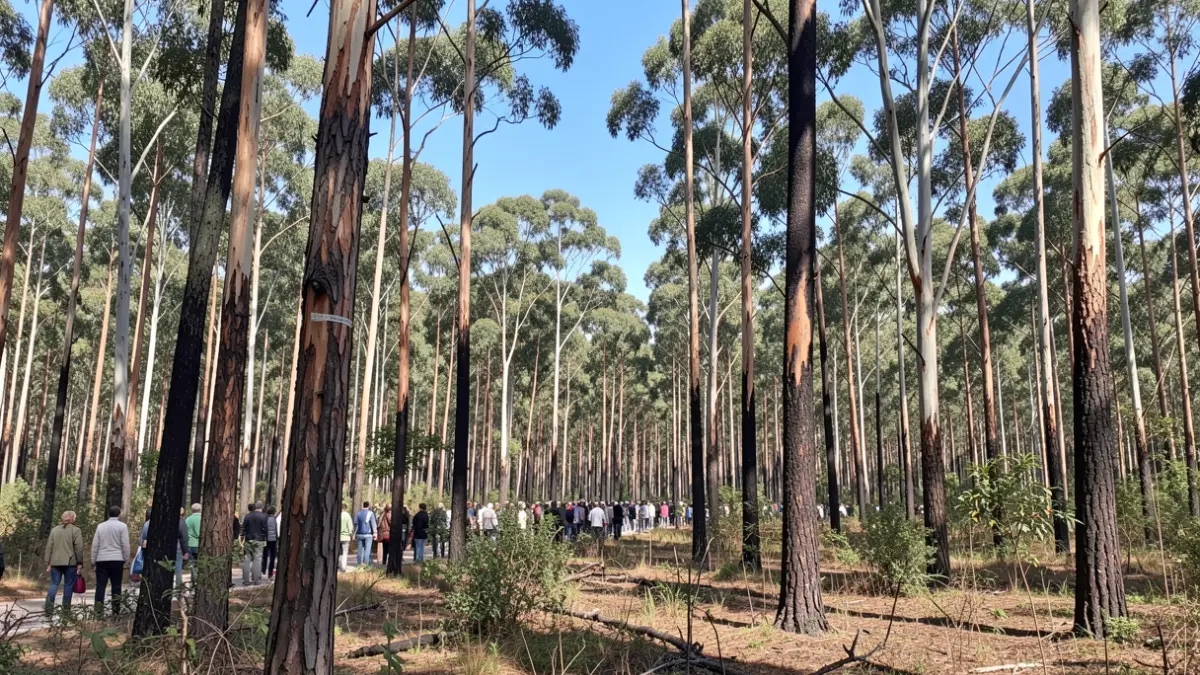
The scale of the Niebla fire, which devastated over 33,000 hectares, cannot be blamed on the presence of eucalyptus trees, according to the Association of Wood and Biomass Utilization Companies of Huelva (Apromabi). The entity, in a statement, asserts that the real problem lies in the "lack of management and investment in silvicultural treatments" of forest masses.
According to Copernicus data collected by Apromabi, 11,813 hectares affected by the fire were eucalyptus plantations, representing 35.10% of the burned area. Of these, 7,728 hectares are on public lands, with 6,458 directly managed by the Regional Ministry of Sustainability and Environment of the Junta de Andalucía, and the remainder by the municipalities of Niebla and Valverde del Camino.
Apromabi criticizes the state of neglect of these forests, stating that the management of eucalyptus, which requires sprout selection treatments every ten to twelve years, has not been carried out in the last 20 years on lands managed by public administrations. This lack of maintenance allegedly led to the accumulation of vegetal material, increasing the risk of large-scale fires.
The association also questions the condition of the firebreaks on public lands at the time the fire started, noting the presence of machinery working on their maintenance. They recall that firebreak work was entrusted to the public company Tragsa, which in turn subcontracts private companies.
Apromabi opposes the Junta de Andalucía's announcement to "eradicate and progressively reduce" the eucalyptus forest mass, arguing that the debate should focus on forest management rather than the species. They point out that the fire also affected cork oak groves, pine forests, and holm oak forests, even on land previously occupied by eucalyptus.
The organization defends that eucalyptus can generate income for administrations, which should be reinvested in forest management and conservation. They extend their criticism to the administrations and political parties of recent decades for the "progressive abandonment" of the forests, concluding that "political management" is responsible for the current state of the forest masses.
As urgent proposals, Apromabi calls for the implementation of soil retention techniques to reduce erosion, the removal of fire-affected arboreal material to prevent pests, and action on insufficiently managed masses. They also request increased investment in prevention, wider firebreaks, and the involvement of specialized local private companies.
Finally, they propose the establishment of a technical working group and offer their collaboration to the Junta de Andalucía, the Provincial Council of Huelva, and the municipalities for the management and recovery of the fire-affected areas.