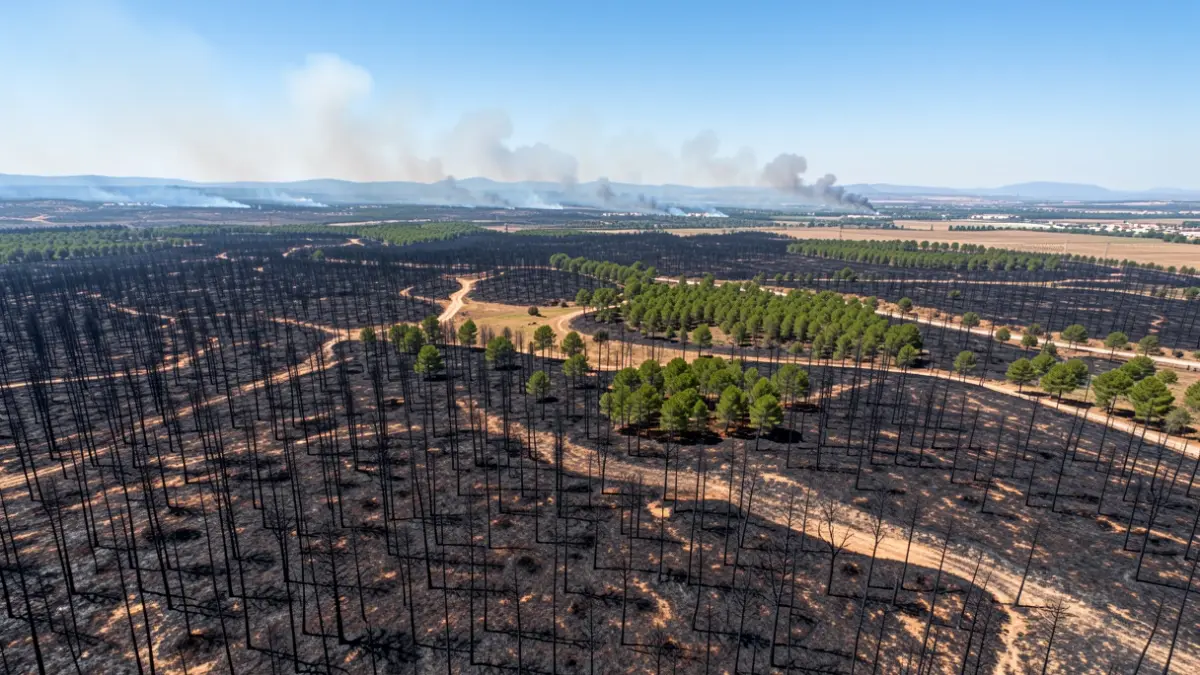
The municipalities of Alosno and Villanueva de los Castillejos, the latter spreading to San Bartolomé and Gibraleón, have been the epicenters of these incidents that required the intervention of a large Plan Infoca task force for several days.
The Andévalo fire, declared on June 8th and extinguished on the 14th, is considered one of the largest in the province this century. It affected a total of 4,395.46 hectares, of which 858 were woodland, over a thousand were scrubland, and approximately 2,500 were pasture. Additionally, 281 non-forest hectares were also damaged.
The Andévalo emergency necessitated the activation of operational situations 1 and 2 of Plan Infoca, mobilizing hundreds of personnel from various institutions such as the UME, Guardia Civil, Policía Nacional, Huelva Firefighters, environmental agents, and local emergency services. Over 500 people and 200 vehicles worked simultaneously, supported by 28 aircraft.
This fire led to the implementation of protective measures for the population, including the preventive evacuation of over 380 people in San Bartolomé de la Torre, the municipality that suffered the worst consequences. Affected residents were able to return to their homes once safety was assured, with no personal injuries reported.
The Alosno fire, which started on June 4th, affected 1,079.87 hectares of forest, with nearly 300 hectares of woodland, 91 of scrubland, and about 650 of pasture. Although smaller in scale and without affecting the population, it served as a reminder of the recurring problem of fires in the region.
“"Having fear and anguish."
Property owners whose land was devastated have requested the declaration of a Seriously Affected Area, a condition recognized by the Government. The Government's deputy delegate, María José Rico, has pledged support for those affected, while noting the need for a comprehensive assessment after the summer.