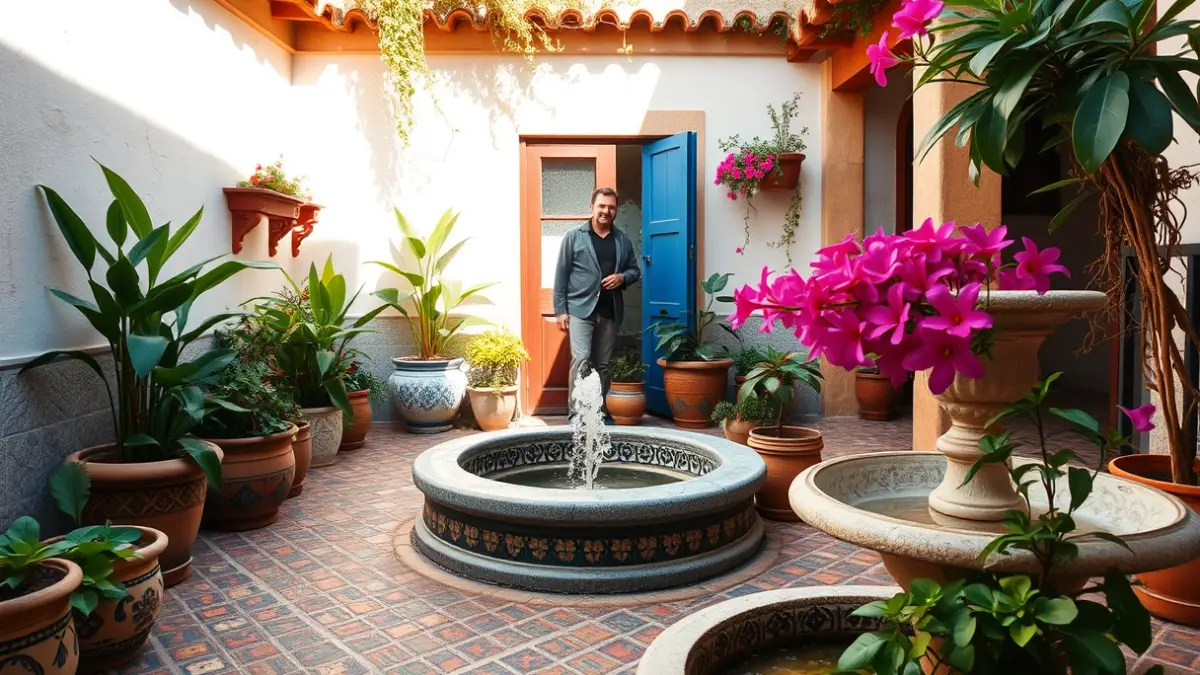
The new edition of the Cordoba Patios Guide, celebrating its twenty-second installment, has been presented as a tribute to the owners and caretakers of these emblematic spaces. The publication, distributed with the newspaper, offers a detailed tour of the patios participating in the municipal competition, which can be visited between May 4th and 17th.
The manual not only explores the history and peculiarities of each enclosure but also underscores the fundamental role of the people who, with their daily efforts, preserve one of Cordoba's four World Heritage declarations. Additionally, it delves into the 11th Provincial Competition of Patios, Traditional Corners, and Grilles, organized by the Diputación de Córdoba.
“"The Patios are not only a World Heritage site but also a way of life and coexistence; something that would be impossible without the caretakers, because without the caretakers, the Patios Festival would not exist."
During the presentation, various authorities highlighted the importance of this tradition. The president of the Diputación de Córdoba, Salvador Fuentes, emphasized the cultural and human dimension of the patios, quoting figures such as Antonio Gala and Pablo García Baena to describe these spaces as the “soul of Cordoba” and places “where flowers sing more than birds.”
For his part, the Minister of Justice, Local Administration and Public Function, José Antonio Nieto, recalled his time as mayor of Cordoba when the Patios Festival was recognized as Intangible Cultural Heritage of Humanity in 2012. Nieto stressed that the key to the success of the candidacy before UNESCO was to give prominence to the caretakers themselves, whose vision and experience proved decisive.
The mayor of Cordoba, José María Bellido, highlighted the value of the patios as a symbol of the city and an expression of generosity, emphasizing the hospitality of those who open their homes. The president of the Andalusian Parliament, Jesús Aguirre, appealed to the emotional and symbolic nature of the patios, describing them as “living poetry” perceived through the senses and which must be transmitted to new generations.