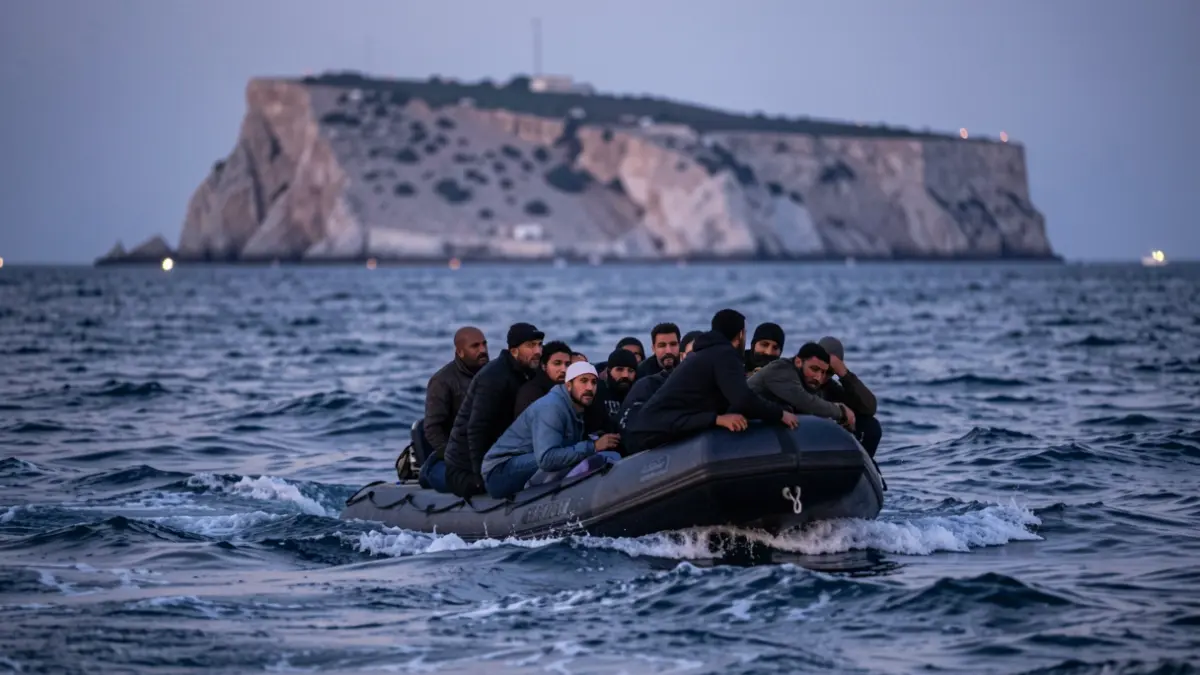
The Strait migratory route has returned to prominence after years of reduced activity. The arrival of various inflatable boats and jet skis carrying dozens of North African migrants to the coasts of Campo de Gibraltar in the past week underscores the reactivation of departures from northern Morocco. This surge coincides with the migratory crisis in Ceuta and occurs amidst apparent laxity in surveillance by Moroccan authorities, while the Guardia Civil and National Police have reinforced Spanish coastal monitoring.
Significant arrivals were recorded on Saturday afternoon and evening: one vessel reached the beaches of San Roque, specifically Puente Mayorga, while bathers were still present, and another arrived in La Línea de la Concepción near midnight. The previous Friday, the Guardia Civil intercepted a boat with eight individuals of North African origin in Punta Carnero (Algeciras), arresting the alleged captain.
These incidents add to a series of arrivals that began the first weekend of August, coinciding with the peak of the crisis in Ceuta. On Sunday, August 2nd, the National Police intercepted two boats in Algeciras and La Línea with 17 people. On Saturday, August 1st, witnesses reported a boat with 15 to 20 individuals near the Punta Carnero lighthouse, four of whom were later arrested.
The expeditions appear to depart directly from Moroccan coasts, taking advantage of periods of reduced surveillance and the confusion caused by the mass entry into Ceuta. Human trafficking networks are reportedly capitalizing on this situation, reviving a route that had lost importance. According to Arabist José Carlos Cabrera, mafias did not orchestrate the Ceuta entry as they gained no direct profit, but they are exploiting the concentration of security forces at the border to facilitate crossings to the mainland, using jet skis (profitable at around 3,000 euros per trip) and boats.
The modus operandi includes approaching the coast, sometimes abandoning migrants near the shore to complete the journey swimming and disperse inland. Jet skis, despite their lower capacity, offer a quick crossing with less risk of detection. Cabrera dismisses any strategic geopolitical interest in these specific arrivals, attributing them to the mafias' decision to profit from the current circumstances.
Historical data contrasts with the current situation. According to a 2026 report by CEAR (Spanish Commission for Refugee Aid), only 347 migrants were recorded on the route from northern Morocco to Algeciras and Cádiz throughout 2025, representing just over 1% of the 32,925 individuals counted at Spanish borders that year.