More than thirteen centuries later, the impact of that event is still palpable in the Campo de Gibraltar. This region, historically a crossroads for various civilizations, underwent a profound transformation with the arrival of Islamic forces, an event that placed Algeciras Bay at the epicenter of Mediterranean history.
In the early 8th century, the Western Mediterranean was in a period of intense transition. The Visigothic Kingdom in Hispania showed signs of institutional weakness, with an unstable monarchy and a fragmented aristocracy. This internal situation, coupled with the rapid expansion of Islam from the East, created a favorable scenario for the incursion. Historical sources suggest that the internal Visigothic division may have facilitated local agreements with the Muslims, which would explain the initial limited resistance in some areas.
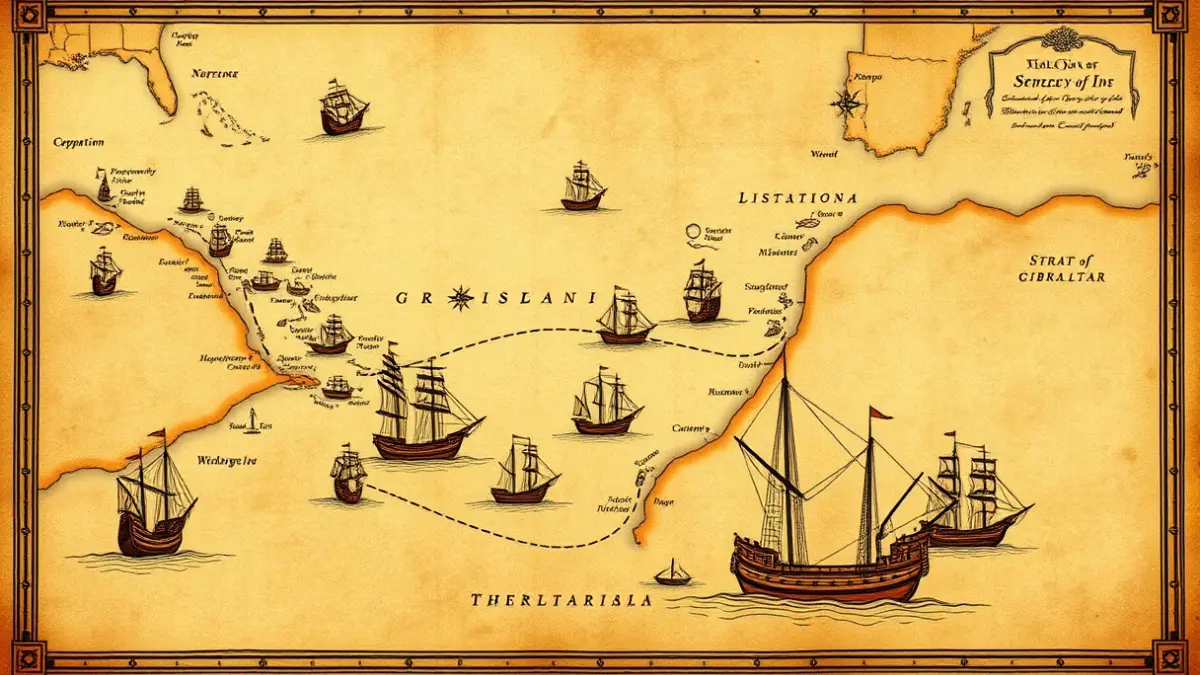
In April of 711, Tariq ibn Zyad, leading a contingent of between 7,000 and 9,000 men, crossed the Strait. Although the Rock of Gibraltar is the point traditionally associated with the landing, Algeciras Bay was the true logistical center of the operation. Its strategic location allowed for a constant supply of troops and fluid communication with North Africa, in addition to offering a natural defensive environment for vessels. This initial control of the coastline was fundamental to the success of the campaign.
Shortly after the landing, the nucleus of Al-Yazira Al-Jadra (the Green Island) was established, a strategic foundation that ensured control of maritime traffic in the Strait and a permanent connection between Al-Andalus and the Maghreb. Algeciras thus consolidated its role as a gateway, military base, and administrative center, roles that would define its history for centuries.
The Muslim advance culminated in July of 711 with the decisive Battle of Guadalete, whose exact location is still debated. The defeat of the Visigothic army was overwhelming, leading to the collapse of central power and paving the way for rapid occupation. Between 711 and 714, Muslim troops reached cities such as Toledo, Zaragoza, and Mérida, extending their dominion over much of the Peninsula.
The legacy of this landing is undeniable in the Campo de Gibraltar. Local toponymy, with names like Gibraltar, Algeciras, Tarifa, or Guadarranque, retains its Arabic roots, reflecting the importance that the Islamic world gave to this region. These names, along with archaeological remains of walls and castles, narrate a history of dominion, transit, and coexistence that has shaped the identity of the region to this day.