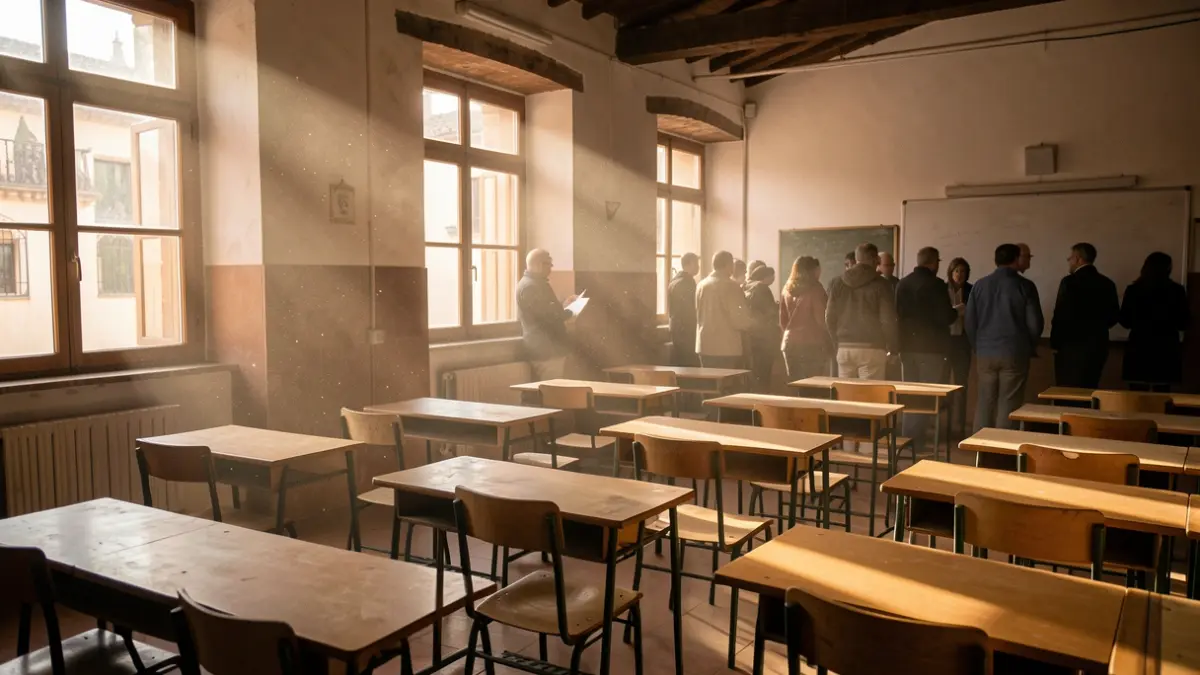
The arrival of summer heat at the end of the school year once again highlights the deficiencies in the air conditioning of educational centers in Cádiz. The Ustea union has indicated that most schools lacking cooling systems far exceed the optimal temperature range set by the Occupational Risk Law, which is between 17 and 27 degrees Celsius.
At the Andalusian level, it is estimated that only about 10% of centers have implemented bioclimatization measures. In the province of Cádiz, areas like Campo de Gibraltar show even lower percentages, while others such as La Janda or Jerez show some improvement, partly due to the attention given since the approval of the 2020 law.
Ustea explains that the first bioclimatization plan identified 140 priority centers in the interior of the province, but the lack of European funds halted the expansion of these measures, especially in coastal areas like the Bahía de Cádiz and Campo de Gibraltar.
To collect incidents, the union platform has launched a form for public Andalusian schools and institutes. The results will be used to prepare a detailed statement, and if necessary, Labor Inspection will be involved.
The Bioclimatization Law, in effect for a decade, is "flagrantly" breached in many educational centers. The union criticizes the lack of political will to enforce regulations that, they claim, have resources but lack the necessary execution.
In some centers, the installation of cooling equipment has caused problems with the electrical grid, as has happened in San Severiano (Cádiz) and Las Salinas (San Fernando). Furthermore, several schools in Jerez, Puerto Serrano, and Campo de Gibraltar continue to hold classes in temporary structures, a situation that has persisted for years.
The union denounces the inaction of various administrations and bodies, including the Guardia Civil, occupational risk prevention units, the judiciary, the prosecution, and the government itself, due to the lack of tools to measure temperature and file reports.
Often, it is the Parent-Teacher Associations (AMPAS) themselves who attempt to mitigate the situation by raising funds to install air conditioning, a solution that shifts responsibility to families and creates inequalities between centers and students.
Beyond cooling systems, the Bioclimatization Law includes other measures such as tree planting, water points, cross-ventilation, and the installation of photovoltaic panels. However, solutions like standing fans are sometimes ineffective in classrooms with high student ratios, with ceiling fans being more efficient.
Ustea calls for a monitoring and adaptation plan, including energy audits, as solutions must be tailored to each center's characteristics. They recall the disparate conditions during the pandemic, with classes held in open-air classrooms in the Sierra while other facilities were air-conditioned.