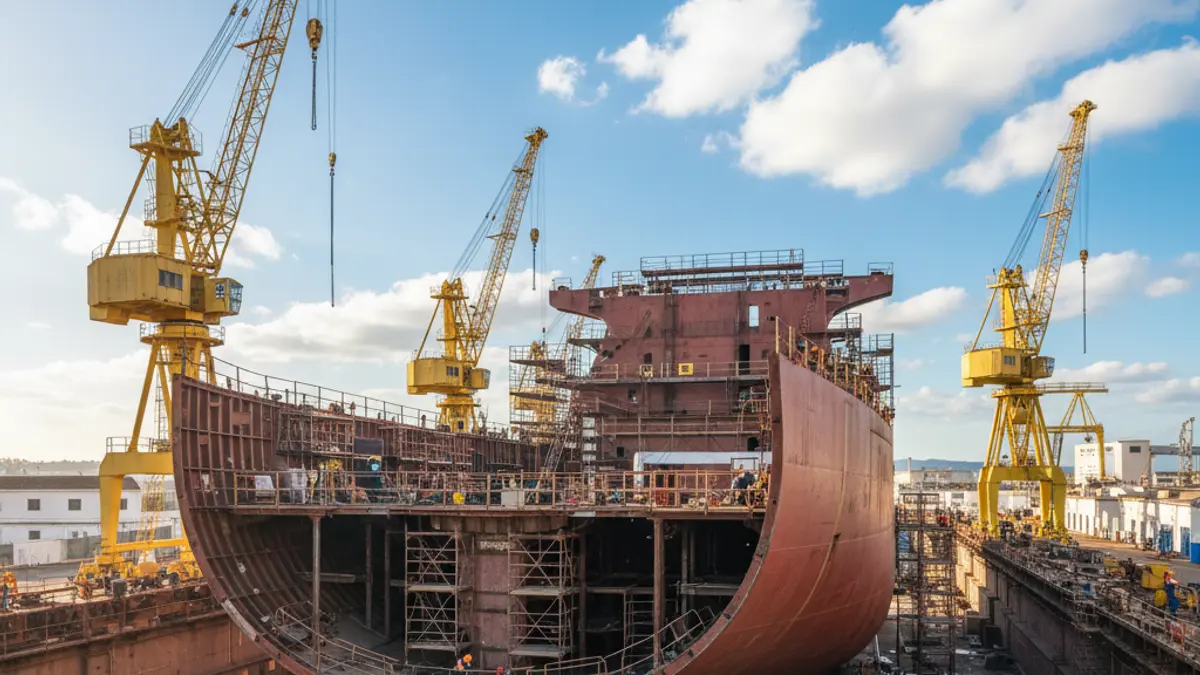
The construction of the BAM-IS, which began in December 2024 with the first steel cut, has reached a crucial point. The recent dry dock placement of a nearly 600-ton macrostructure at the Matagorda shipyard means that only three blocks remain to complete the vessel and proceed with its flotation.
“"The program is proceeding according to the planned schedule, demonstrating the commitment and efficiency of the entire team involved."
This macrostructure, composed of three blocks, will house essential components such as Voith cycloidal thrusters, a high-capacity crane, an organic hyperbaric chamber, and the work deck, where underwater intervention equipment will be installed. The vessel is designed to meet the operational requirements of the Spanish Navy, especially after the integration of the S-80 class submarines.
Its capabilities include deep-sea underwater intervention, submarine repairs, recovery of submerged objects, search and detection of objects, hyperbaric treatment for diving accidents, protection of submerged archaeological heritage, and support for diving unit training. Additionally, the BAM-IS will be able to transport a rescue mini-submarine and conduct explorations with unmanned vehicles up to 3,000 meters deep, utilizing an AUV from the Norwegian company Kongsberg.
The project has generated approximately 1.3 million working hours and about 1,100 jobs, including direct positions, auxiliary industry roles, and supplier company roles. The new BAM-IS will replace the Neptuno Rescue and Salvage Ship and will become the main unit of the Navy for supporting diving operations, being the first Spanish vessel with MOSHIP certification to act as a mother ship for NATO and United States submarine rescue systems.