
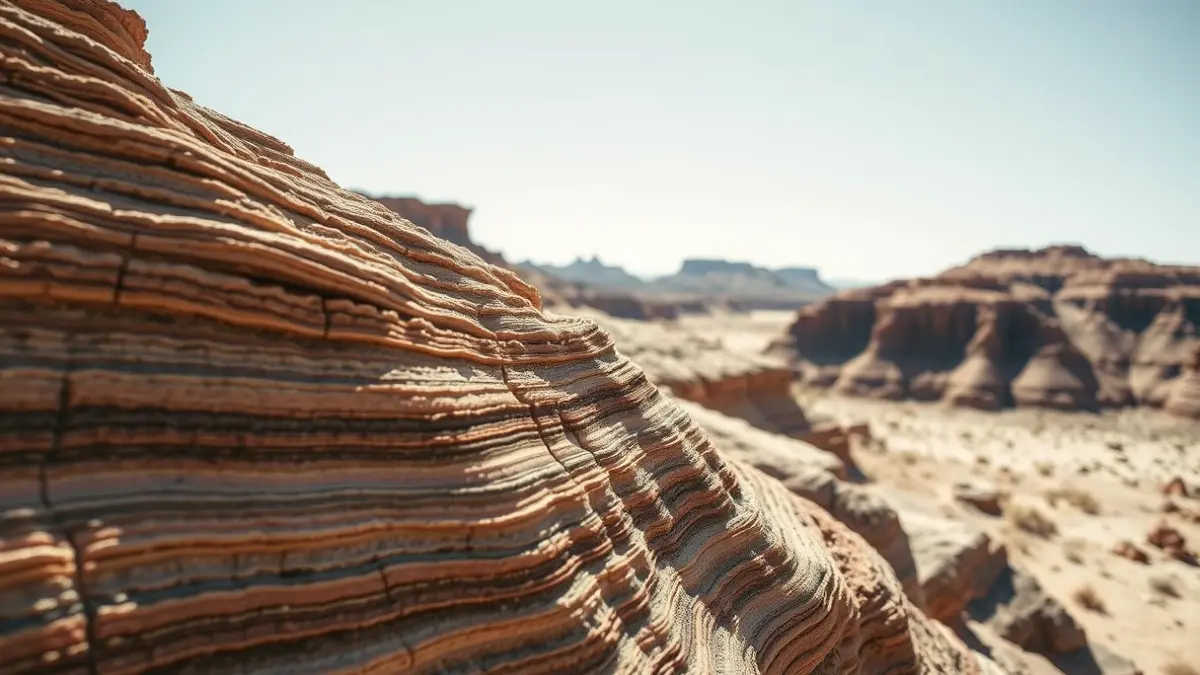
The soil of Almería preserves a geological sequence that offers a detailed insight into the ancient desiccation of the Mediterranean Sea. A scientific team has examined these rock formations, identifying the physical evidence that documents the sea's transformation from an open state to an environment dominated by salt and, eventually, by continental sediments.
The deepest layers of this geological record indicate a starting point with an open sea, characterized by abundant fossil life and signs of normal water circulation. This scenario suggests a connected and stable Mediterranean, conducive to marine life without restrictions.
However, moving up the sequence, a progressive change is observed. The diversity of marine organisms decreases, giving way to more resilient species. This transition, though gradual, points to an increasingly restricted environment where water renewal became less efficient.
The clearest indicator of this process is the appearance of gypsum layers. This material forms exclusively when evaporation significantly exceeds water inflow. In Almería, the recurrent presence of gypsum at different levels suggests that the Mediterranean experienced multiple episodes of water loss, rather than a single catastrophic event.
Among these saline layers, the reappearance of marine life remains is a crucial detail. This finding demonstrates that the sea did not disappear abruptly but rather alternated phases of extreme dryness with periods of partial recovery of its volume.
The pattern revealed by the rocks indicates that the Mediterranean entered cycles of intense dryness, followed by wetter phases that allowed for partial system recovery. It was not an immediate point of no return, but an unstable equilibrium. Each cycle left its mark, with higher salinity, reduced circulation, and an ecosystem adapted to increasingly harsh conditions, which ultimately transformed the environment completely.
Researchers attribute this phenomenon to a combination of factors. Tectonics played a fundamental role by progressively closing connections with the Atlantic, which reduced water inflow and increased vulnerability to evaporation. This isolation was compounded by drier climatic phases and sea-level drops, creating a scenario where evaporation exceeded water inflow, favoring salt accumulation.
The geological record of Almería is not an isolated case; it aligns with findings in other areas of the Western Mediterranean, confirming that this process occurred simultaneously across various regions. Furthermore, microscopic fossils and magnetic signals present in the rocks have allowed for the establishment of a precise chronology of this episode's evolution.
The study, titled A new sedimentary record from the Tabernas Basin: Implications for the Messinian Salinity Crisis in the Western Mediterranean, was conducted by a team of researchers from the University of Barcelona and the University of Alicante, as part of their investigations into Mediterranean geology and basin evolution during the Messinian Salinity Crisis.


