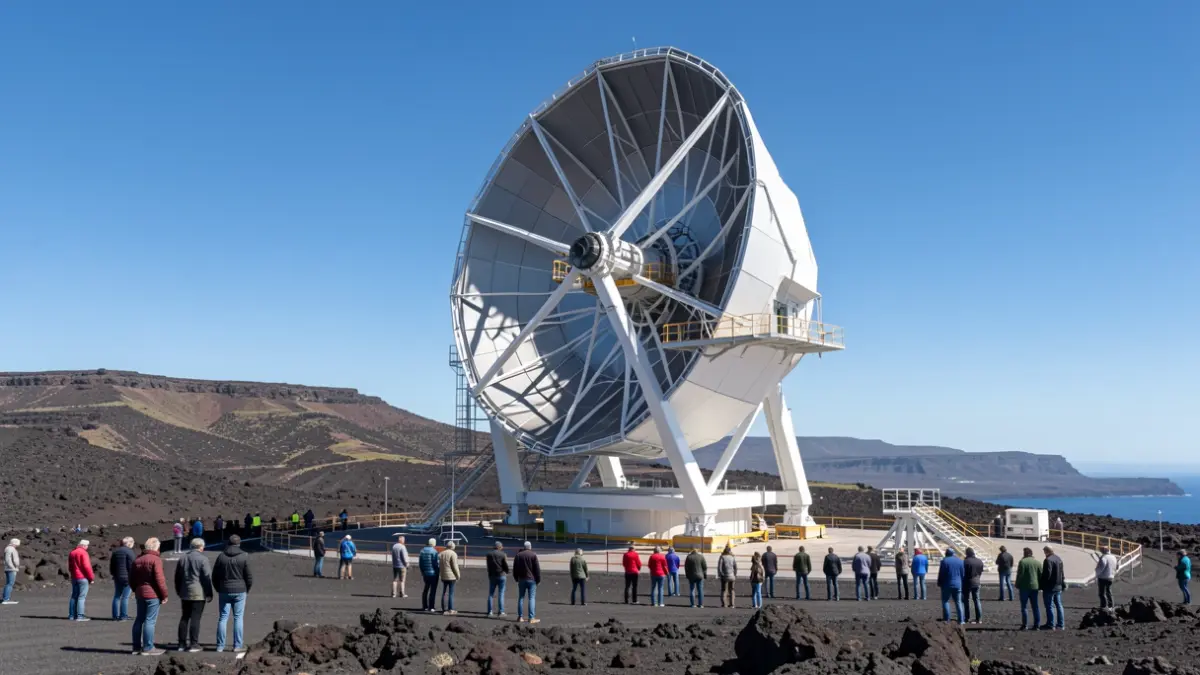
The Andalusian Institute of Astrophysics (IAA-CSIC) is part of the EST project from its inception, contributing to its scientific, technological, and institutional development. The designation as a Landmark, adopted at the 97th ESFRI meeting in Cork on September 23-24, 2026, is a significant milestone for this infrastructure, included in the ESFRI Roadmap since 2016.
Landmarks are strategic research infrastructures for Europe, either operational or in an advanced implementation phase. EST will enable observation of the Sun with unprecedented detail, enhancing the understanding of its activity and its impact on Earth's space environment, complementing space missions.
Manuel Collados, coordinator of EST, emphasizes the necessity of European collaboration for a project of this scale. "No single institution or country could undertake an infrastructure of this magnitude alone," he stated. The recognition supports European collaboration and provides momentum to initiate construction.
The project, led by Spain, involves the Canary Islands Institute of Astrophysics (IAC) and the CSIC through the IAA. Both institutions have been members of the EST Foundation since 2023, alongside eight other entities from seven European countries.
Luis Bellot, head of EST at IAA-CSIC, notes that the challenge includes developing cutting-edge instruments. "These technological developments are a decisive contribution from the CSIC to the project and require highly advanced engineering capabilities," he explained, with support from the Ministry of Science, Innovation and Universities (MICIU).
The telescope will provide the European scientific community with a shared observation infrastructure designed to address scientific questions that current instruments cannot tackle. It will be built at the Roque de los Muchachos Observatory in La Palma, Spain.
Its 4.2-meter diameter primary mirror and instruments are designed to observe the solar atmosphere at different heights and wavelengths simultaneously, studying how magnetic fields transport energy and trigger solar flares. This will aid in understanding physical processes relevant to other astronomical contexts, such as the magnetism of low-mass stars or the habitability of orbiting exoplanets.