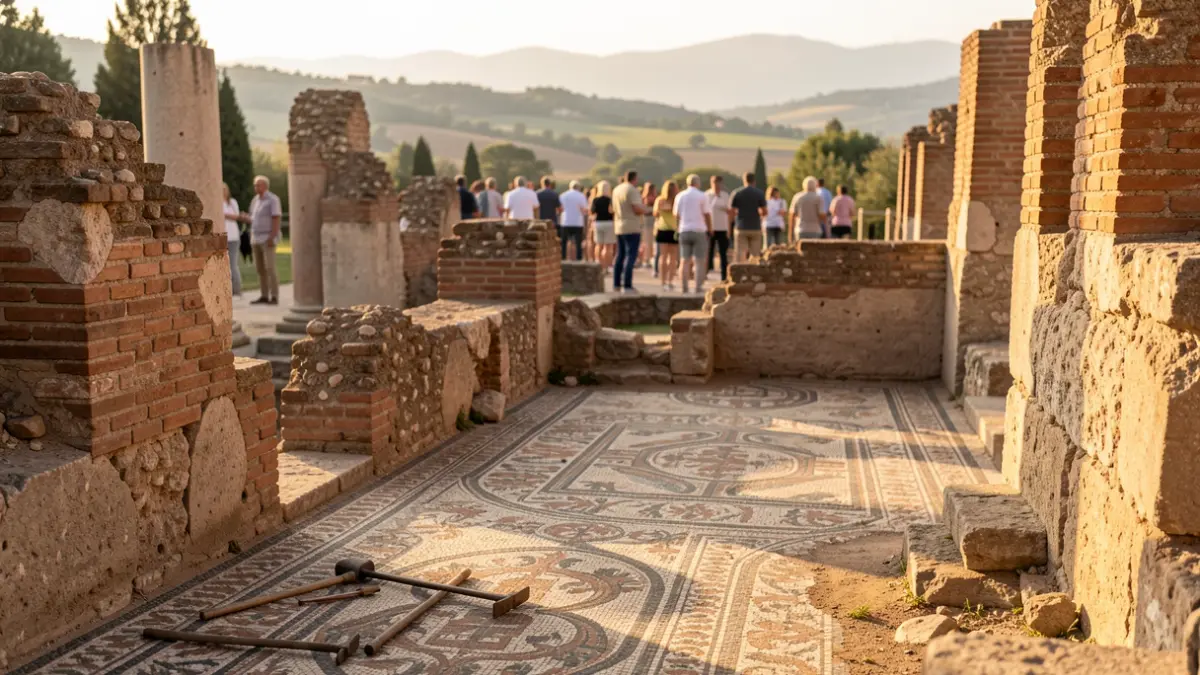
Conservation, restoration, and improvement works at the archaeological site of the Villa del Mitra in Cabra are consolidating the Mithraeum and thermal areas, as well as enhancing access to the complex. These actions will allow for the resumption of public visits once completed.
The intervention, part of the ‘Project for the Conservation, Restoration, and Rehabilitation of the Mithraeum and adjacent spaces at the Villa del Mitra’, has a budget of €62,097.24. It was promoted by the Cabra City Council and the Provincial Council of Córdoba, aimed at preserving historical-artistic heritage.
The works focus on consolidating and restoring the Mithraeum, new thermal spaces, and the northern access sector, discovered between 2022 and 2023, to prevent deterioration from atmospheric agents. The thermal area is also being protected, and the access to the enclosure modified to prevent visitors from walking on the archaeological structures. Drainage will be improved, invasive vegetation removed, and reproductions of original mosaics at the Municipal Archaeological Museum will undergo a thorough cleaning.
The mayor of Cabra, Fernando Priego, highlighted the collaboration of the Provincial Council of Córdoba and the involvement of the technical team and the awarded company Hermanos Campano, specialists in the restoration of archaeological sites.
Priego recalled that enhancing the value of the Villa del Mitra is a priority objective, noting that the City Council promoted its declaration as a Site of Cultural Interest in 2016 and acquired the corresponding land in 2018, aiming to transform it into a visitable space and showcase one of the most important Roman complexes in the southern province of Córdoba.
The Villa del Mitra, cataloged as an Archaeological Zone, has undergone excavations since 1972, uncovering residential areas, mosaics, and sculptures. Research conducted between 2022 and 2023 documented thermal spaces and a potential Mithraeum, the third found on the Iberian Peninsula, adding significant scientific value.
The discovery of the Mithraeum has increased interest from national and international researchers and specialists. The current intervention will allow for the proper conservation of these structures, improve their interpretation, and facilitate public knowledge and enjoyment, according to the mayor.
Francisco Casas, municipal delegate for Heritage, explained that the site already offered free visits. Following the intervention, the complex will be reconditioned, and open and guided tours for groups will be reinstated.
The director of the intervention, Blanca García, indicated that the works are in their final phase and highlighted the conservation of the Mithraeum, which was in a state of significant deterioration, now allowing for a clearer understanding of this cult space's structure.
The City Council has applied for new funding from the Provincial Council of Córdoba to continue expanding knowledge and the visitable area of the Villa del Mitra, with a project costing €87,337.80 for excavations on a northern plot acquired in 2025.
This future action includes demolishing existing constructions, conducting new excavations, restoring any structures that may appear, expanding the visitable zone, and designing a fencing and covering system to protect the complex.
Fernando Priego concluded that they are promoting Cabra's culture, heritage, and projection so that the significant archaeological and tourist resources, where public funds are being invested, benefit the local society through conservation, dissemination, and visitor engagement.