For those experiencing this festivity for the first time, understanding its distinctive elements is crucial. The Fair transforms Seville into its own universe where tradition, music, gastronomy, and social life intertwine, creating an experience often enigmatic for outsiders.
Among the pillars of the Fair are the sevillanas, a traditional dance and song that has evolved from the Castilian seguidilla into a unique genre with flamenco influences. Its current form, with series of four verses and specific choreographies, was consolidated in the 19th century and is danced in pairs or groups.
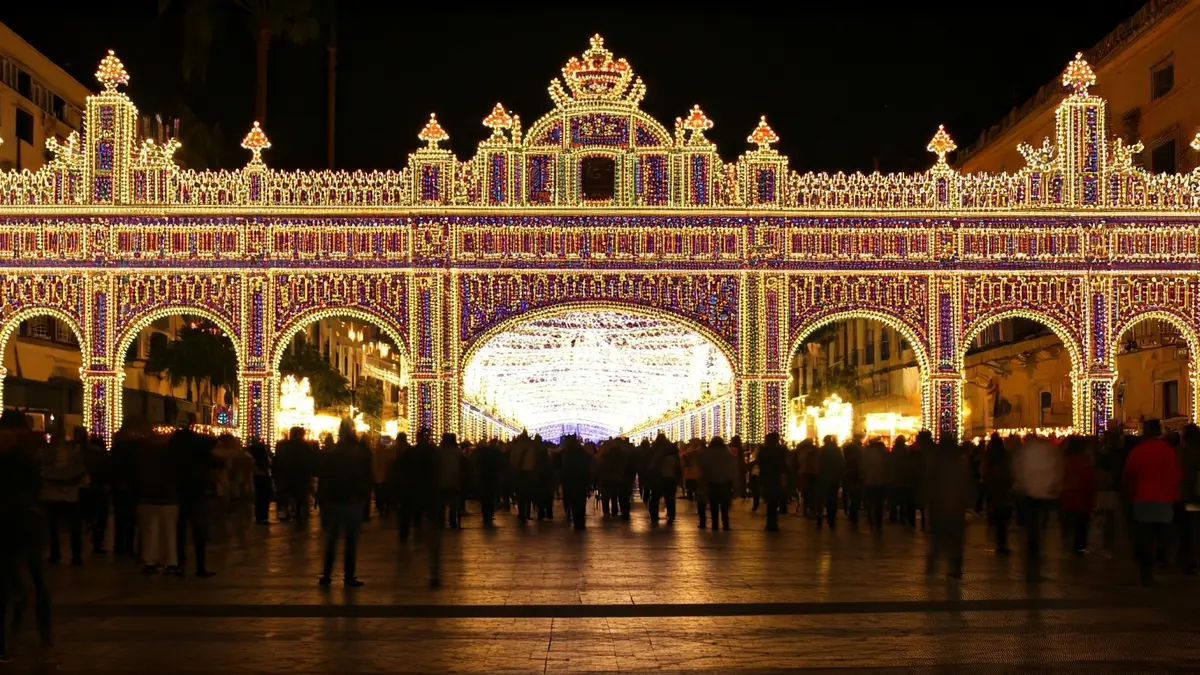
Another unmistakable symbol is the Portada, the majestic main entrance to the fairgrounds. Each year, its design pays homage to a significant monument or event in the city. The Portada of the Seville April Fair 2026, for example, is inspired by the Portuguese Pavilion from the 1929 Ibero-American Exposition and Charles V's gazebo in the Alcázar, a work by Davide Gambini.
The heart of the celebration is the Real de la Feria, the physical space where the event takes place, located between Los Remedios and Tablada. It is divided into three areas: the Real itself, the Calle del Infierno, and the parking lots. The origin of its name has generated various theories, from the 25-cent peseta fare charged by coachmen, to its authorization by Queen Isabel II, or its connection to the military camps of the Reconquista, according to the Royal Spanish Academy (RAE).
The casetas are the soul of the Fair, functioning as temporary homes where Sevillians and visitors gather to eat, drink, dance, and socialize. Their origin dates back to shaded areas used by merchants to close deals, evolving into the current structures that foster community.
The traje de gitana, also known as the flamenco dress, is the quintessential attire. Its origin is attributed to the work clothes of Gypsy women, which over time were adopted and embellished by the upper classes. The 1929 Ibero-American Exposition solidified it as the indispensable outfit for the Fair.
The Calle del Infierno (Hell Street) is the popular name for the amusement park adjacent to the Real, where rides are known as “cacharritos.” Covering an area of 87,000 square meters with nearly 400 activities, it offers entertainment for all ages, from mechanical rides to tombolas and shows.
Finally, the Alumbrao marks the official start of the April Fair. This magical moment occurs at midnight on Pescaíto Monday, when all the light bulbs of the fairgrounds are progressively lit from the Portada, welcoming a week of celebration.