Plan Romero 2026: Over 7,000 Personnel for El Rocío Pilgrimage Security
The largest security deployment with advanced technology and a new integrated operational coordination center is activated.
By Manuel Cano Heredia
••3 min read
AI
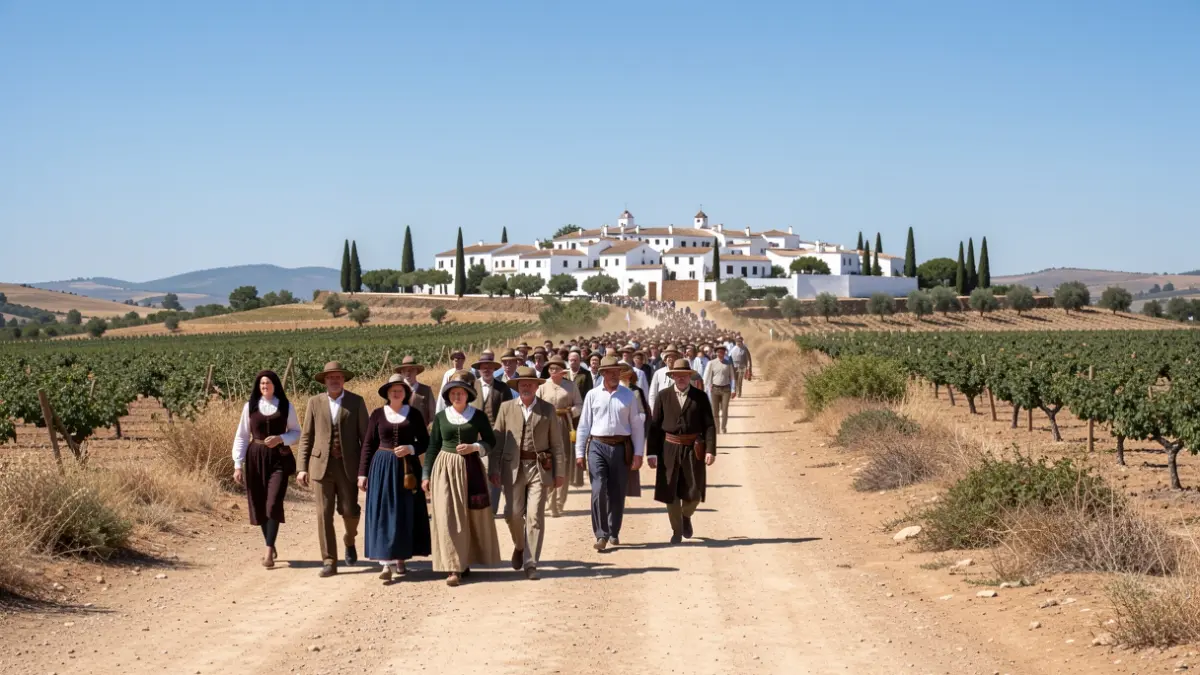
Generic image of a pilgrimage in Andalusia.
Plan Romero 2026 has activated an unprecedented security deployment with over 7,000 professionals stationed in Seville, Huelva, and Cádiz for the El Rocío Pilgrimage.
The 42nd edition of Plan Romero, which will take place between May 18th and 28th, has been activated by the acting Minister of Health, Presidency, and Emergencies, Antonio Sanz. The operation, designed to ensure the safety of pilgrims, is divided into four distinct deployment areas: Caminos in Seville, Huelva, Cádiz, and the Aldea (village).
One of the main novelties is the launch of the new Integrated Operational Coordination Center (Cecopi). This permanent infrastructure, which centralizes emergency coordination year-round, represents an investment of over four million euros and enhances response capabilities for large public gatherings.
The deployment falls under the Andalusian Civil Protection Territorial Emergency Plan (PTEAnd) and integrates personnel from EMA 112, health services from 061 and the Andalusian Health Service, Guardia Civil, National Police, local police forces, DGT (General Directorate of Traffic), Environmental Agents, Maritime Rescue, Red Cross, and Civil Protection volunteers.
The new Cecopi features an expanded operations center and a healthcare attention center covering over 500 square meters. The National Police Unit Adscribed to the autonomous community provides 70 officers for facility surveillance and environmental protection tasks, among others.
“
"Plan Romero is the most significant large-scale deployment in Southern Europe, both in terms of the number of personnel, the kilometers of pilgrimage routes, and the natural environment in which it takes place, the Doñana Natural Space."
The healthcare operation, coordinated by the 061 Emergency Health Center, includes a permanent healthcare center within the Cecopi with seven medical offices, a mobile diagnostic imaging unit, a triage area, and an observation room. Over 200 healthcare professionals will staff this center, supported by 13 assistance posts along the pilgrimage routes, a medicalized helicopter, and 31 healthcare vehicles.
“
"The objective is to guarantee an agile and effective response under any circumstances, offering pilgrims advanced healthcare adapted to the environmental challenges."
Technological advancements include the creation of a high-precision orthophoto of the village and the development of a 'digital twin' to integrate operational variables and anticipate risks. Communications are enhanced with the Junta's Emergency Network (Reja), and the ES-Alert system will be used for mass notifications. Drones with thermal cameras and intelligent capacity control systems will also be employed.
The special EMA Infoca plan includes the daily deployment of up to seven aerial units and over thirty ground units for forest fire prevention in the Doñana area, given the medium risk of fires during this period.
Regarding the brotherhoods (hermandades), several have already begun their journey, including those from Córdoba, Écija, Estepona, Málaga, Osuna, Puente Genil, Carmona, El Viso del Alcor, Lucena de Córdoba, Tocina, and Torremolinos. A total of 127 brotherhoods will participate in this year's pilgrimage.
“
"The operation is based on 'planning focused on prevention, constant monitoring of the territory, and immediate intervention capacity to ensure the safety of pilgrims and the protection of natural heritage'."
“
"Antonio Sanz has asked the pilgrims to once again follow the instructions of EMA 112 to balance celebration and safety throughout the pilgrimage route."