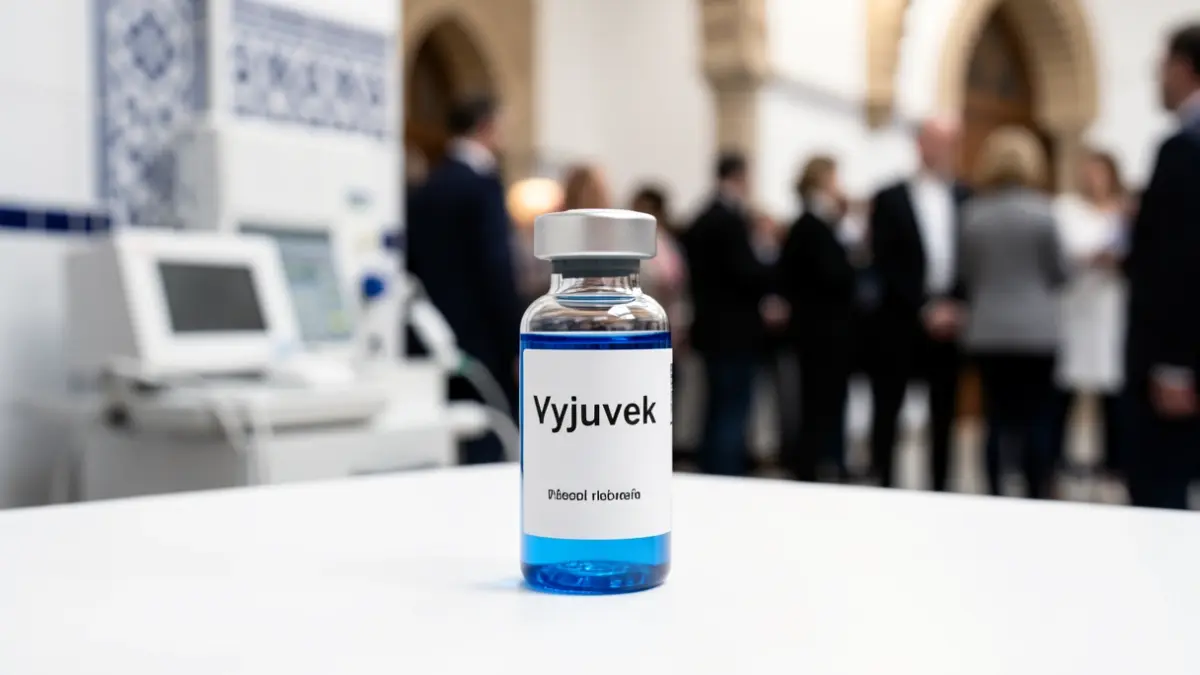
The hospital center, part of the Andalusian Health Service, is the first in the province to dispense this drug, which has proven to significantly improve the quality of life for those affected by this severe genetic condition. The Junta de Andalucía has pioneered its national funding.
The delegate of the Andalusian Government in Almería, Aranzazu Martín, participated in a meeting at the hospital with the first beneficiary patient, Patricia Lupión. Also attending were the mayor of El Ejido, Francisco Góngora, the territorial delegate for Health, Juan de la Cruz Belmonte, the hospital's general director, Pedro Acosta, and the heads of the Pharmacy and Dermatology units, María Ángeles Castro and Carlos Hernández, respectively.
Aranzazu Martín emphasized the commitment of the Junta de Andalucía government, led by its president Juanma Moreno, to incorporate this treatment into the National Health System and negotiate a more affordable price, given its current estimated cost of 100,000 euros per patient per month.
This new drug helps patients improve chronic wounds, reduce associated pain and complications, thereby facilitating a more normal life and the ability to perform daily activities.
“"Although it's still early, we are seeing results from the first day, and many of the chronic wounds I've lived with for years are starting to close, and with them, the daily pain is decreasing. For the first time, I see the future with hope and optimism."
The territorial delegate for Health, Juan de la Cruz Belmonte, announced that the treatment will be progressively administered to other patients in the province under strict multidisciplinary team control, with another patient at the same hospital expected to benefit soon.
The hospital's general director, Pedro Acosta, detailed the thorough preparation and coordination between the Pharmacy and Dermatology teams, including protocols for drug conservation, handling, and professional training for its correct administration.
The mayor of El Ejido, Francisco Góngora, congratulated Patricia Lupión and thanked the Junta de Andalucía's Ministry of Health for their commitment to healthcare and their sensitivity towards these patients, also recognizing the work of the professionals at the Poniente University Hospital.
Dystrophic Recessive Epidermolysis Bullosa (EBD), the most severe variant of 'butterfly skin', is a rare genetic disease causing extreme fragility of the skin and mucous membranes, leading to blisters and wounds from the slightest friction. It affects between 2.4 and 6 people per 100,000 inhabitants in Spain.
The drug Vyjuvek, a topical gene therapy, uses a genetically modified virus to deliver functional copies of the COL7A1 gene. Applied to wounds, it enables cells to produce the missing type VII collagen protein, temporarily restoring anchoring fibrils.
According to María Ángeles Castro, head of Hospital Pharmacy, this drug, unlike others, does not integrate into the patient's genome, reducing risks but requiring periodic application as skin sheds. Its handling demands strict biosecurity measures and precise dosing.