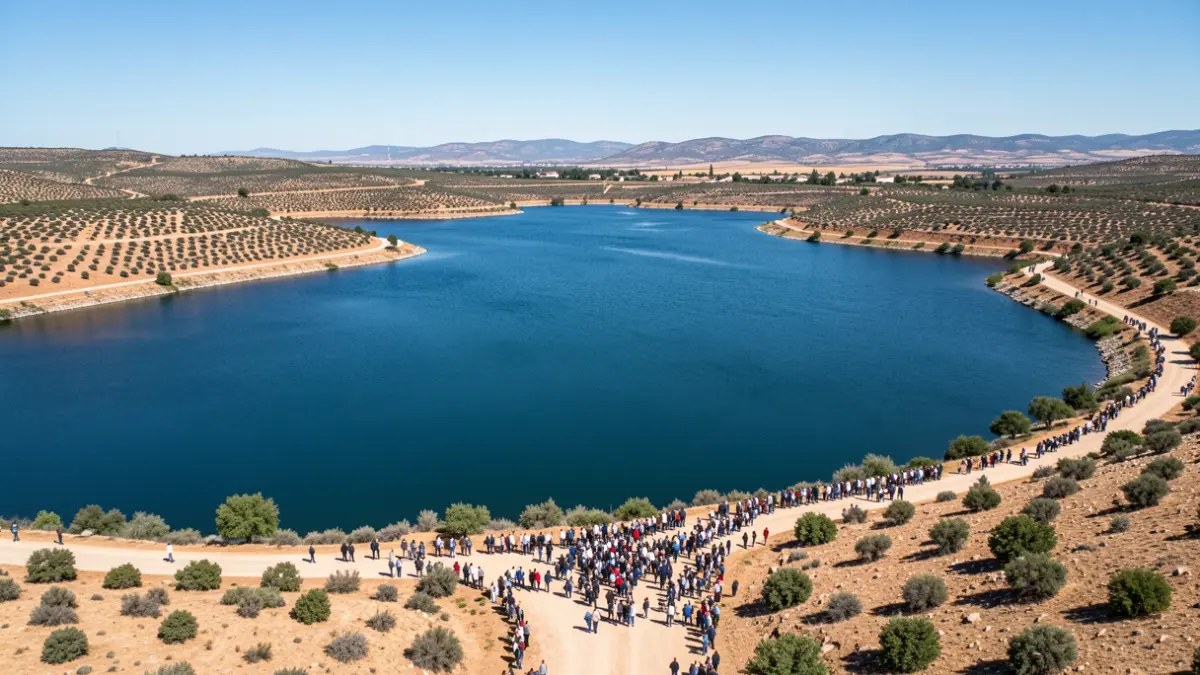
The recent heatwave in Andalusia signals the end of the rainy season and the beginning of a promising summer for the region's reservoirs. The hydrological year, concluding on September 30th, has been exceptionally good for Andalusian water reserves.
Five Andalusian provinces -Málaga (96%), Cádiz (90%), Huelva (91%), Jaén (90%), and Córdoba (90%)- have surpassed 90% of their reserves. They are closely followed by Seville (86%) and Granada (80%), according to official data. The exception is the province of Almería, whose reserves barely reach 12.2%, despite experiencing a pluviometric year above the historical average in some of its stations.
The three main reservoirs in the autonomous community reflect this excellent situation. The Iznájar reservoir, the largest in capacity, stands above 88%, a level not seen since 2013. The Guadalcacín reservoir in Cádiz reaches 93%, a state similar to March 2013. Meanwhile, the El Tranco de la Sierra de Cazorla dam, which had suffered droughts in the last decade, is now close to 93%, a significant contrast to the less than 50% recorded a year ago.
Meteorological forecasts indicate a reinforcement of the subtropical ridge, which will maintain high temperatures next week. However, the good news is that Andalusian reservoirs are facing this early summer at their peak.