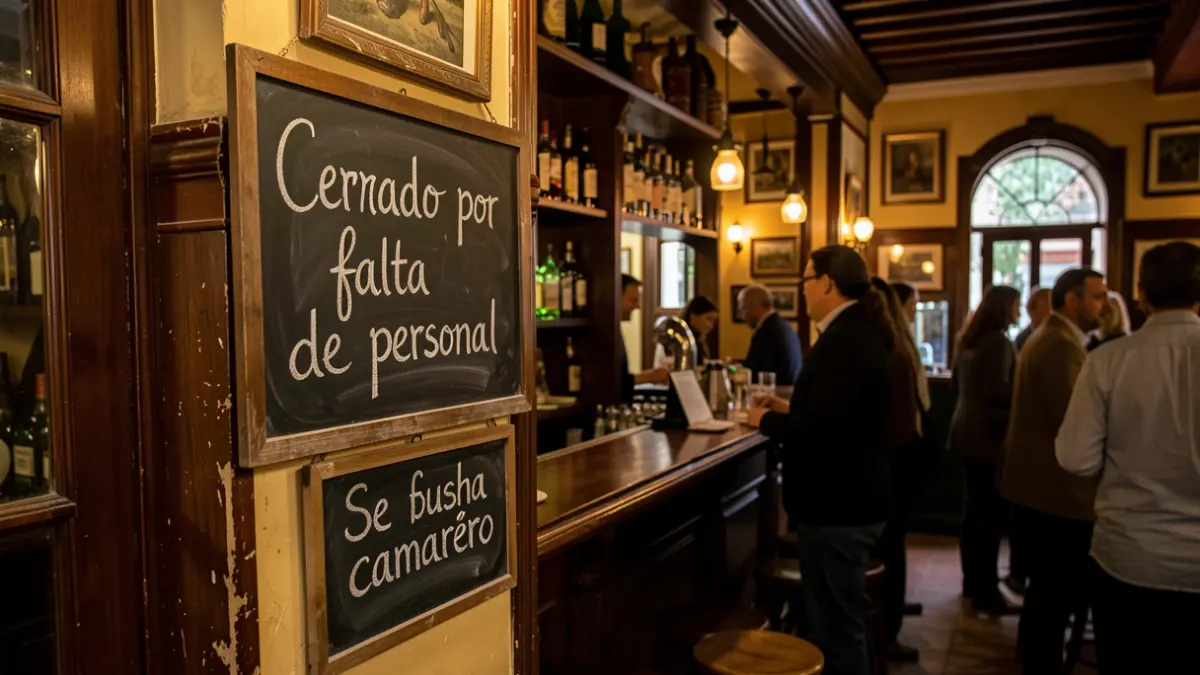
The scarcity of skilled labor in Málaga's hospitality sector has become a recurring issue, impacting the operations of numerous businesses. Establishments like the bar Malamente, located in the Huelin neighborhood, are compelled to close temporarily or desperately seek staff. Owner Irene Flores, along with her husband Mario Lupo, manages this cocktail bar and an adjacent Italian restaurant, both struggling to find the necessary personnel, particularly trained and experienced waiters.
Flores highlights the critical situation, needing at least three full-time employees and one extra for the bar, as well as staff for the restaurant. She criticizes that despite offering above-minimum wages (between 1,300 and 1,600 euros net), with eight-hour shifts and two days off, many qualified candidates "don't want" to work or leave after only a few hours. "Nine out of ten" applicants are foreigners, many without work permits, or Spaniards lacking experience who are unfamiliar with the profession.
Javier Frutos, president of the Association of Hoteliers of Málaga (Mahos), confirms that the problem is widespread. "There are establishments that can no longer open every day because they cannot find staff," he states. It is estimated that the sector requires approximately 7,000 employees to manage the summer campaign on the Costa del Sol, a figure that seems difficult to achieve given the lack of qualified candidates.
Leandro Kowalczuk, manager of the beach bar Nuevo Mediterráneo, also acknowledges the difficulty in finding qualified personnel. Although his business, having multiple locations, can rotate staff to cover needs, he admits that "some people last a day, a week, or just hours" due to the high pressure and fast pace of work at a beach bar.
Arturo Martín, manager of Brasería de Puerto Niza and La Carmela, points out that many businesses offer "garbage conditions," making it hard to attract professionals. Despite this, Javier Frutos defends that the sector "increasingly offers better working conditions" and that many entrepreneurs "pay above the collective agreement," though he acknowledges the need to make businesses "more attractive" in terms of work-life balance and salaries.
Manuel Villafaina, president of the Association of Beach Businesses of the Costa del Sol, explains that they "save the summer" by hiring university students and regrets that many foreign applicants lack the necessary documentation. He criticizes the "unrealistic criticism" towards the sector over the past 15 years, asserting that 99% of businesses comply with labor regulations.