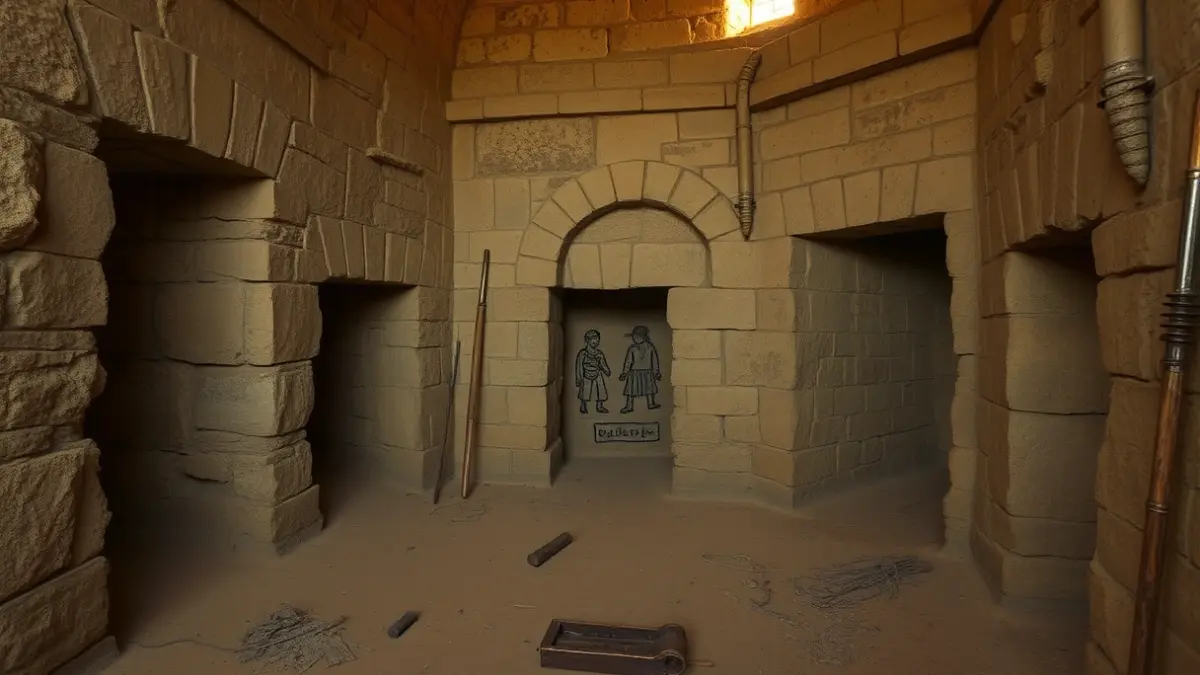
Preliminary work for the restoration of the towers at Sabiote Castle has brought to light an important archaeological discovery within the Homage Tower. This intervention has allowed for the identification of previously unknown dependencies, notably several subterranean passages approximately 1.8 meters high.
One of the most unique elements of this discovery is the charcoal 'graffiti' found on the walls of these galleries. They feature names and dates, as well as drawings of crosses and spears. These inscriptions have been dated between 1548 and 1560, providing valuable insight into the life and use of these spaces in the heart of the 16th century.
Initial studies suggest that one of the located chambers could correspond to a large cistern, equipped with a water collection system from the tower's roof. The nozzles in the western area, which would have channeled water into its interior, have already been identified.
The discovered dependencies are currently filled with a substantial amount of rubble. Among these materials, arch voussoirs, bricks, construction debris, and ceramic fragments dating from the Late Middle Ages to the Modern Age, specifically between the 15th and 17th centuries, have been identified.
This discovery gains even greater significance when placed within the monument's history. In 1537, a secretary to Charles I acquired the castle of Sabiote. Between 1537 and 1543, he spearheaded a profound renovation of the old Hispano-Muslim alcazaba, transforming it into a prominent Renaissance palace.
The Sabiote City Council has expressed its satisfaction with these findings, which will be brought to the attention of the Culture Delegation for further study and evaluation. The mayor emphasized the significance of the discovery, stating that Sabiote once again demonstrates that “under its stones sleeps the history of Spain.”