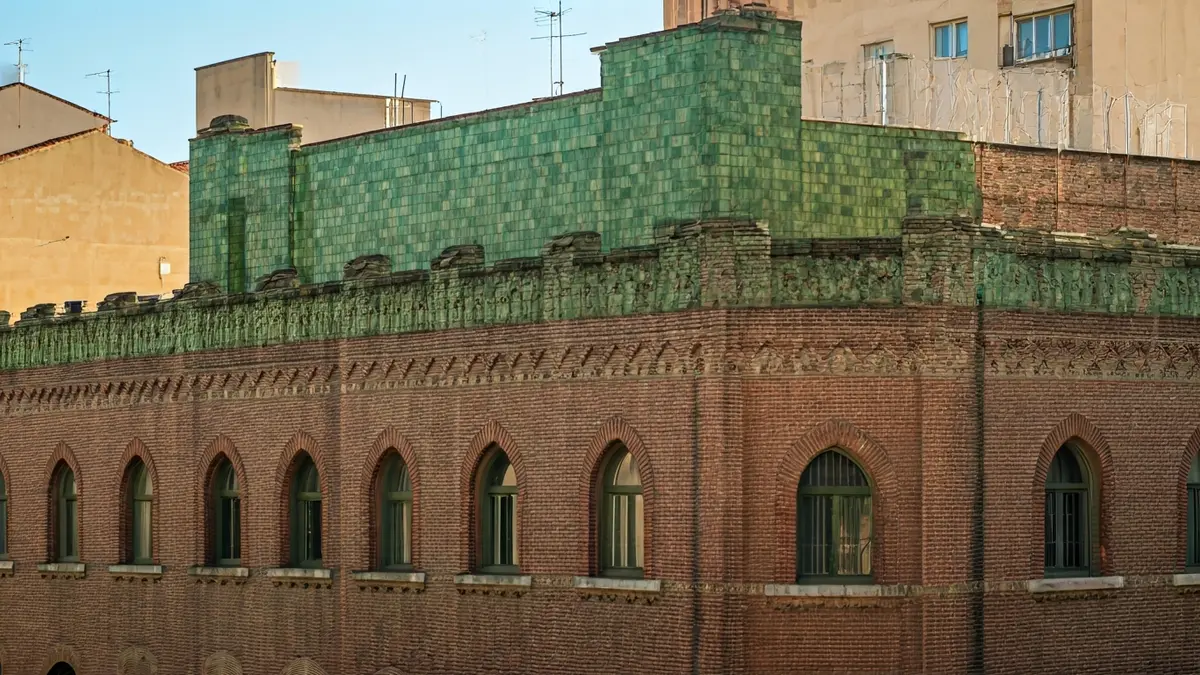
During the first decades of the 20th century, Jaén underwent a transformation, expanding northward and turning the Paseo de la Estación into a showcase of modernity. In this context, developers and architects erected unique buildings, including a beautiful industrial nave at the corner of the Paseo and the old Fuerte del Rey road, intended to house an innovative perfume factory.
Behind this project was Inocente Fe Jiménez, born on December 28, 1880, in Jaén. Despite his humble origins, Fe Jiménez, a professional teacher and draftsman, combined his work in public administration with a successful entrepreneurial career. The company, named Florfé, emerged from the surnames of its founders, Flórez and Fe, with Inocente Fe as manager. Its offices were located on Bernabé Soriano street, and the factory on Paseo de Alfonso XIII, dedicated to producing essential oils and perfumery products.
Florfé's products, with evocative names like «Aromas de Diamela», «Ambarina», and «Nerolia», as well as lotions and soaps, achieved great prestige. Thymol, one of its star products, won the Grand Prize of Honor at the industrial and commercial fair in Barcelona in 1917. The quality of its essential oils crossed borders, with offices in Madrid and agencies in cities like Grasse, New York, and Paris, establishing Florfé as an internationally recognized industry.
The Florfé building, designed by the Madrid architect Manuel Mendoza, became an architectural gem of the Paseo. Its brick, cement, and stone facade, adorned with green tiles and a cornice with pinnacles, gave it a modernist air. This industrial complex, along with Antonio Tobar Larena's Harinera San Francisco flour mill, represented the entrepreneurial spirit of an era when Jaén was committed to modernity.
Beyond his business success, Inocente Fe Jiménez was a significant political figure. He was elected councilor in 1917 and, in October 1920, became mayor of Jaén by Royal Order, making him the first documented Andalusian nationalist mayor. He signed the Córdoba Manifesto in 1919, participated in the Andalusian Congress of Ronda, and was a friend of Blas Infante. His political tenure included the creation of pensions for municipal workers and the promotion of the Provincial Museum.
Inocente Fe's house, located at number 18 on Bernabé Soriano street, is another example of the architectural richness of the era. Built in 1921 by Manuel Mendoza, it incorporated elements of the Spanish Golden Age, creating a harmonious facade and a highly refined interior. Unfortunately, this heritage has suffered progressive deterioration, with interventions that have obscured its original beauty.
After Florfé closed, the building had several lives, serving as a barracks for the Guardia de Asalto and the Policía Armada, a warehouse, and a gymnasium. In the 1980s, it was abandoned and fell into disrepair. In 1995, the demolition of the barracks sparked controversy due to the high cost and the aesthetic outcome of the intervention, which locals dubbed «Jaén's Puerta de Alcalá».
In June 2005, during the construction of the new Avenida car park, the facade of the old building was dismantled with the promise of reassembling its pieces. However, the arches never returned, and their fate remains uncertain. Today, the site is the Plaza de los Perfumes, a space that, although retaining the name, shows few traces of the original factory, with a brick outline that fades with time.
The figure of Inocente Fe Jiménez, who passed away on September 21, 1968, endures as a symbol of entrepreneurship, commitment, and vision for Jaén. Although his factory and its arches have disappeared, the memory of that industrial dream and the «perfume» of a better future still linger in the city's air.