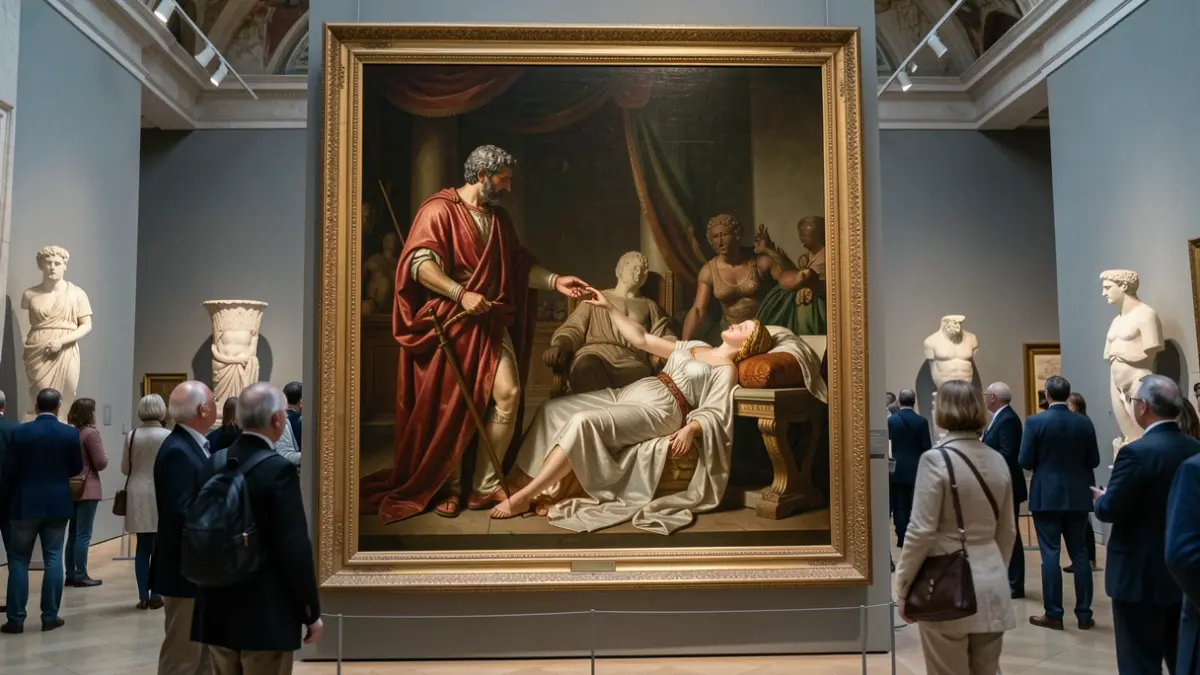
The Museum of Jaén has commenced the restoration of 'Nero Before the Corpse of Agrippina', one of the most recognized works by Arturo Montero y Calvo. The intervention is being carried out in collaboration with the Prado Museum, which deposited the 1887 painting. According to the territorial delegate for Culture, José Ayala, the artwork has been housed at the Museum of Jaén since its founding in 1915, loaned by the then Ministry of Public Instruction and Fine Arts. The large-format canvas (500x331 cm) was installed last year in the remodeled Patio de San Miguel of the museum, alongside 'Rea Silva' by Rafael Hidalgo de Caviedes, thus completing the exhibition's narrative with Roman archaeological pieces.
The restoration process, undertaken this July by specialized restorers, aims to aesthetically recover the artwork and ensure its future conservation. The work has begun with the cleaning and dismantling of the frame, a delicate operation given the piece's dimensions. Subsequently, darkened varnishes will be cleaned to reveal the original colors, previous minor interventions will be removed, and the pictorial layer and support will be consolidated, including the repair of small tears and deformations.
Similar to the restoration of 'Rea Silvia', visitors to the Museum of Jaén can closely follow the restoration process, accompanied by a museum restorer. These guided tours will allow attendees to learn about the different stages of the work on the painting, currently displayed in the Patio de San Miguel. Upon completion of the restoration, the remodeling of the Patio de San Miguel will be finalized, aiming to create a dialogue between the museum's Archaeology and Fine Arts sections through the Roman world, juxtaposing classical antiquity sculptures with dramatic 19th-century pictorial interpretations of this period.
Arturo Montero y Calvo (Valladolid, 1859-Madrid, 1887) painted 'Nero Before the Corpse of Agrippina' in 1887, the same year it received the second medal at the National Exhibition of Fine Arts. The work, referencing a passage from Suetonius about Nero's murder of Agrippina, became his posthumous and most acclaimed piece. The artist, already ill while working on the painting in Rome, passed away before seeing it exhibited. The canvas, presented unfinished, garnered significant public interest due to both its artistic merit and the shock of the painter's death.