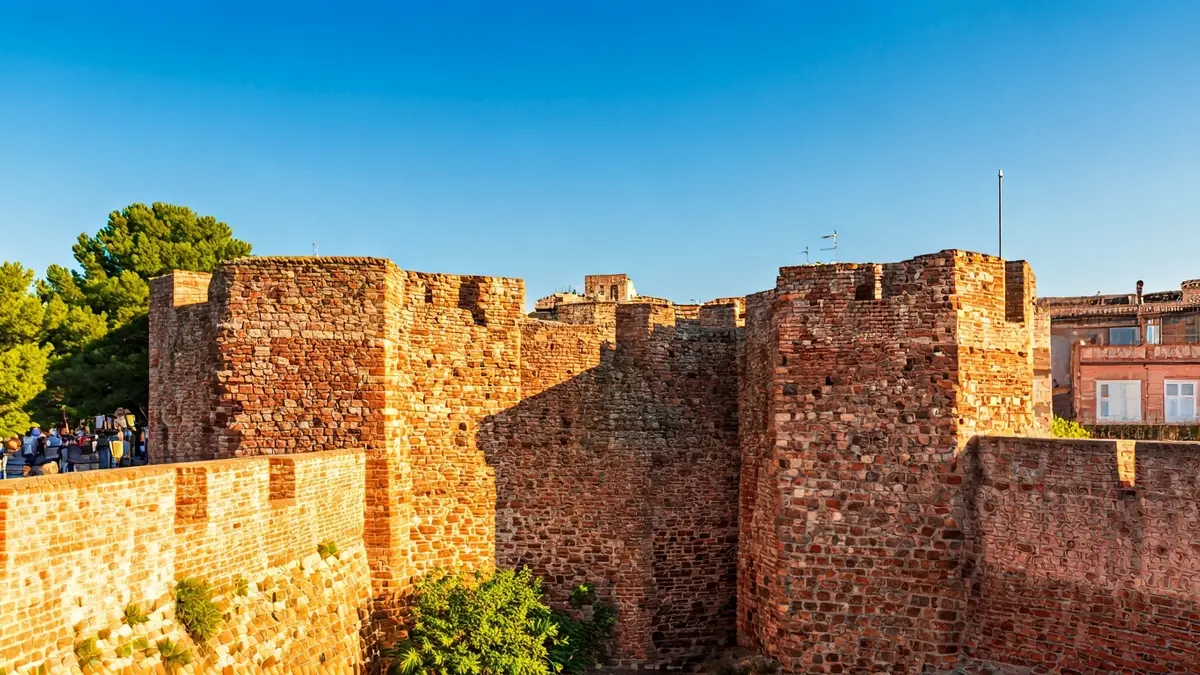
Visitors arriving in Niebla for the first time are often struck by the sheer scale of its walls. This imposing structure of red earth encircles the urban core, evoking an ancient defense that seems to preserve the town's intrinsic character. Viajar magazine has featured Niebla in a report, emphasizing its age and the excellent preservation of its walled enclosure, considered one of the most significant in Europe.
The walls of Niebla, with their distinctive reddish hue, bear witness to centuries of history. This color is attributed to the clay soil used in their construction, which led to the city being known as “the red one” during the Muslim era. Spanning almost two kilometers, this defensive belt stands on pre-Roman foundations, having been reformed by Romans and Muslims, and has withstood countless conflicts throughout time.
Along the wall, approximately fifty watchtowers are distributed, guarding the horizon just as they did centuries ago. Five main gates, such as those of Sevilla, El Socorro, El Buey, El Embarcadero, and El Agua, still mark the entrances to the city today, inviting visitors to delve into its past.
Its history is the history of southern Europe.
Niebla's historical significance is undeniable. During the Muslim period, it served as the capital of a taifa that extended across much of what is now the province of Huelva and even the Portuguese Algarve. Phoenicians, Romans, and Visigoths also left their mark on its streets, shaping a cultural legacy evident in every corner. Its strategic location next to the Río Tinto, with its reddish waters, made it a coveted stronghold for conquerors and armies for centuries.
Inside its walls, Niebla offers a serene atmosphere with quiet streets and whitewashed squares. The imposing Castillo de los Guzmanes stands out, built on an ancient Arab alcazaba and now considered one of the municipality's symbols. From its towers, the panoramic view of the wall and its surroundings is simply unforgettable. Furthermore, it is the fortress with the most towers in Andalusia.
The Church of Santa María de la Granada, which was a mosque before becoming a Christian temple, is another example of Niebla's cultural blend and a notable specimen of Andalusian Gothic-Mudéjar architecture. The entire historical complex has been recognized as a Site of Cultural Interest, confirming the heritage value of this town in Huelva.