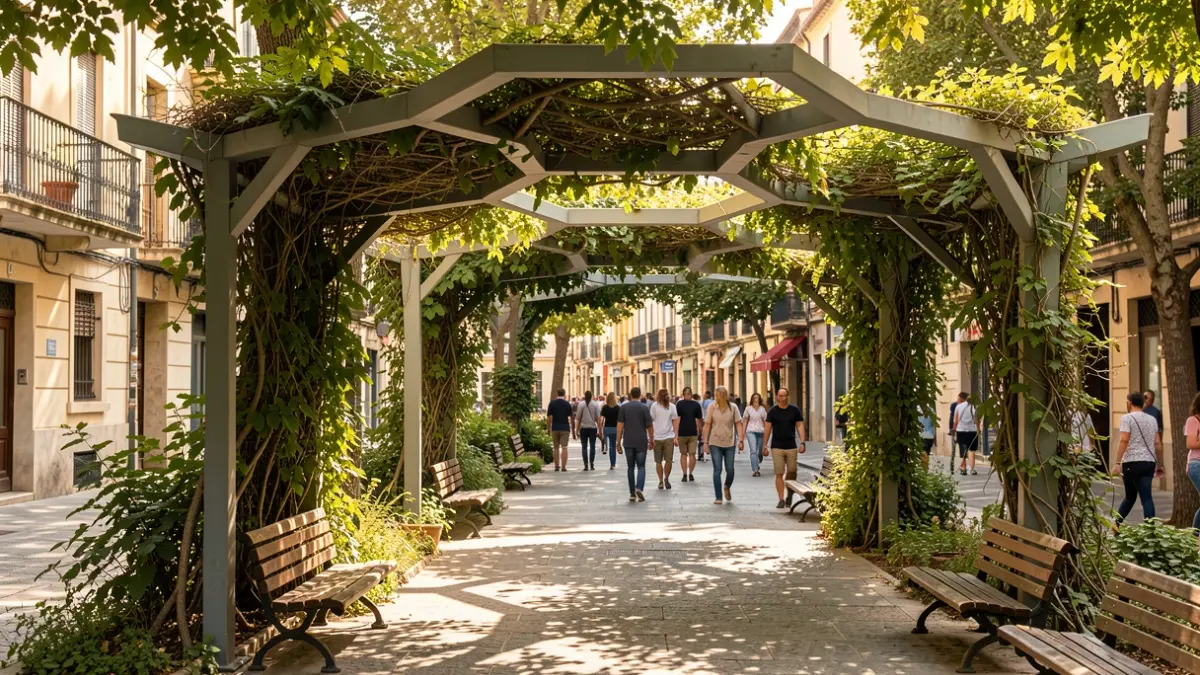
Given the annual recurrence of scorching summers, where sunny sidewalks become deserted and pedestrians seek the shade of buildings, the Granada City Council has started planning a long-term strategy to adapt the city to a heat that is now a constant reality. The main proposal involves creating a network of 45 urban shade islands along the city's main thoroughfares.
This itinerary, exceeding ten kilometers, will not be a continuously covered route but rather a path where pedestrians will find a space to rest, drink water, and shelter from the sun every few minutes before continuing their journey. The project, part of the Integrated Action Plan Granada Cohesion Connection 2030, aims to connect the Norte, Chana, and Zaidín districts, concentrating investment from European EDIL funds.
Interventions will take place on streets such as Camino de Alfacar, Periodista Luis de Vicente, Joaquina Eguaras, Ribera del Beiro, Carretera de Málaga, Camino de Ronda, Avenida de América, Avenida de Dílar, and Pintor Manuel Maldonado, among others. Along this route, 45 rest stations will be located, designed as small climate refuges strategically placed according to usual pedestrian routes and needs identified by neighborhood associations.
The network will feature three major reference spaces, one in each district: the Plaza 28 de Febrero in the Norte district, the Bulevar Rector Gallego Morell in La Chana, and the Bulevar de la Torre de la Pólvora in Zaidín. These points will serve as meeting hubs and will also have a cultural dimension, with plans to host concerts and performances throughout the year.
Each shade island will incorporate elements to reduce thermal sensation. The project includes the installation of 157 self-supporting bioclimatic pergolas with a hexagonal design, prepared for integrating vegetation. An additional 206 new trees of species adapted to the Mediterranean climate, 70 drinking water fountains, and the replacement of 4,195 square meters of concrete and asphalt with permeable pavements are planned.
Furthermore, 23 urban school gardens will be created, and the 38 public Infant and Primary education centers in the city will be climatically adapted, with an investment of 2.8 million euros dedicated to new shade areas, vegetation, and water facilities in schools.
The municipal intention goes beyond merely combating the heat, conceiving these spaces as places for community interaction where residents can converse or participate in activities. The mayor, Marifrán Carazo, highlighted that these functional structures incorporate vegetation and resting areas, and it is anticipated they could host small cultural events and neighborhood activities, aligning with Granada's bid for European Capital of Culture 2031.
This climate refuge project represents one of the first large-scale initiatives considering heat as a defining factor for future urban design. The goal is to create a more walkable city in summer by linking small rest areas along the most used pedestrian routes. If the projected timelines are met, the tender will be published in July, and the first works will commence before the end of the year, marking the beginning of a new way to navigate Granada: from shade to shade.