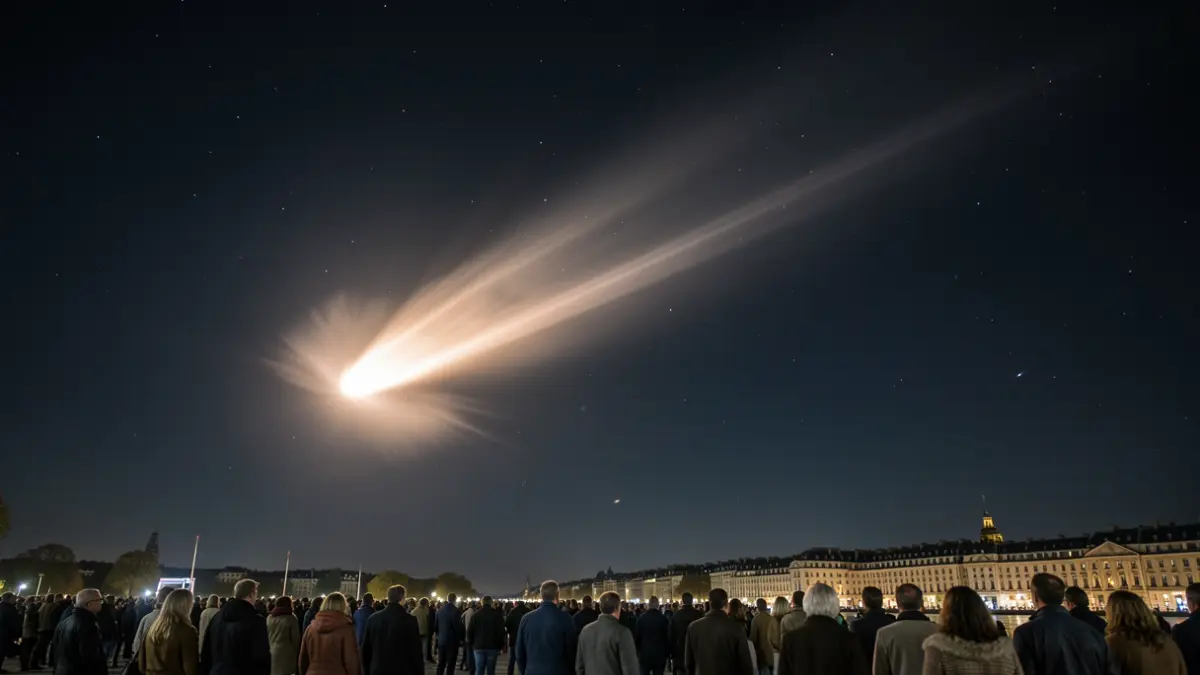
The Institute of Astrophysics of Andalusia (IAA-CSIC), based in Granada, has presented the most complete analysis to date of the explosion of comet 17P/Holmes, an astronomical event that occurred in October 2007 and astonished the world.
This comet experienced a nearly half-million-fold increase in brightness, becoming visible to the naked eye, and its coma, the cloud of gas and dust surrounding it, temporarily appeared larger than the Sun. The study, published in Monthly Notices of the Royal Astronomical Society and led by IAA-CSIC, aims to explain the physics behind this phenomenon.
The research allows for the estimation of the amount of matter expelled, the number of particles released, and their size. Researcher Maria Gritsevich highlighted that this is the first study offering a complete historical summary of all documented outbursts of 17P/Holmes since its discovery in 1892.
Cometary outbursts are sudden and unpredictable increases in a comet's brightness and activity, expelling large amounts of dust and gas. Despite being recurring phenomena, their physical triggers are not yet fully understood. Previous investigations had not managed to explain the complex expansion of the material ejected by 17P/Holmes.
The team analyzed historical observations between 1892 and 2021, focusing on the 2007 event. They estimated the amount of dust released, the size of the particles, and their expansion based on recorded brightness changes.
“Our results suggest that large cometary outbursts can be explained by the expulsion of enormous amounts of extremely fine and porous dust,” explained Gritsevich. She added that this material efficiently scatters sunlight, causing the comet's sudden and drastic increase in brightness.
The study indicates that extreme episodes like the one in 2007 can arise naturally from the release of vast quantities of very small particles, rather than necessarily from the comet ejecting an exceptionally large mass of material. Research professor Alberto Javier Castro, a co-author, stated that the work's findings are essential for future simulations of cometary dust trails and future comet missions.
Material expelled during major cometary outbursts can sometimes cross Earth's orbit, leading to meteor showers. Although 17P/Holmes is not currently associated with any visible meteor shower from our planet, its study helps understand how comets feed into meteoroid streams and contribute freshly ejected dust particles to interplanetary space after episodes of extreme activity.
Gritsevich concluded that the work could help in the future to identify and analyze material released by comets that only transitorily passed through the Solar System or even by comets that no longer exist due to complete disintegration.