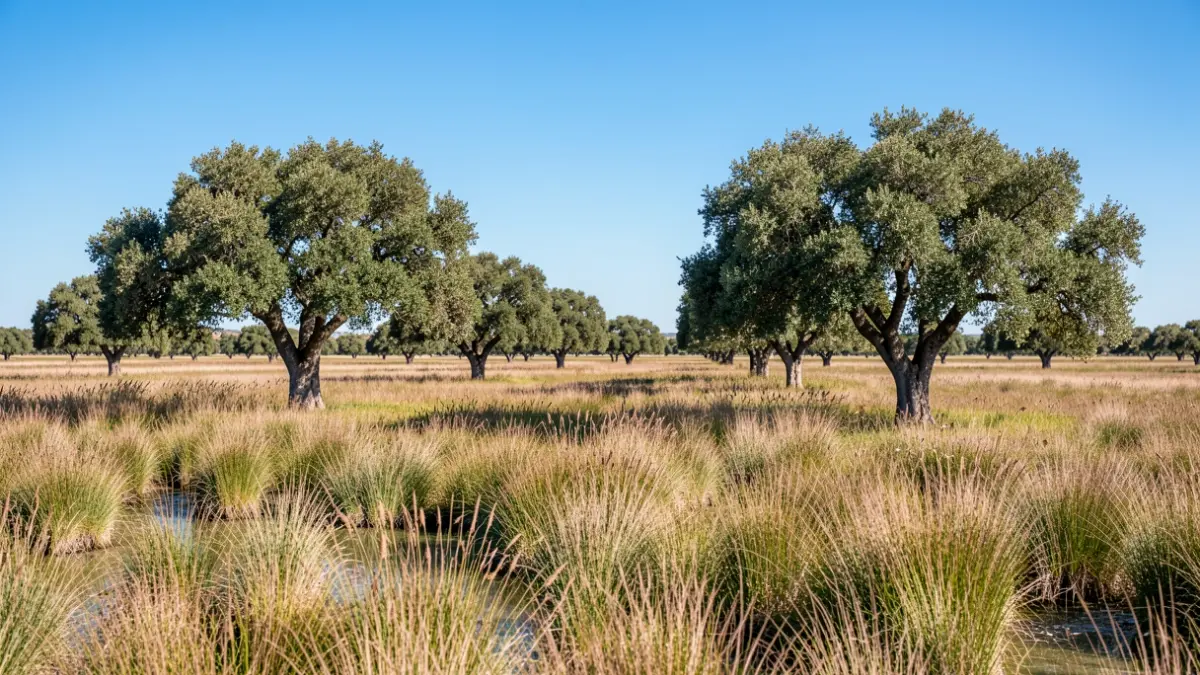
After the conquest of Niebla in 1262, King Alfonso X integrated the extensive marshes between Mures and the Guadalquivir into the Castilian Crown, reserving them as a royal hunting ground through a decree in 1269. In this territory, now known as the Coto de Doñana, the monarch ordered the construction of a modest hermitage by the Rocinas stream. Although the exact date of its foundation is unknown, it is estimated to be between 1269 and 1284. Tradition and the style of the carving suggest the involvement of the Wise King, with the first written mention of Santa María de las Rocinas dating back to 1335.
The original structure, in Mudejar style, measured ten varas in length and had a wooden roof. Inside, it housed a polychrome birch wood carving, dated to the late 13th century, belonging to the lineage of the so-called 'Alfonsine Virgins,' disseminated in the newly conquered lands to solidify the new Christian geography. This image shared a mission with other devotions promoted by the monarch.
A popular legend, first written down in 1758, tells how a hunter from Villamanrique, Gregorio Medina, discovered the image of the Virgin among the brambles of an old wild olive tree in the early 15th century. Following a supposed miracle where the carving mysteriously returned to the tree, a chapel was erected at the site. Although the legend emerged centuries after the hermitage's documented existence (1335) and the carving (13th century), it reflects the genuine devotion and the historical dispute between Almonte and Villamanrique for preeminence.
Devotion solidified in the 17th and 18th centuries. The chaplaincy established in 1587 by Baltasar Tercero attracted new devotions. In 1653, Almonte proclaimed the Virgin its Patron Saint, adopting the current invocation of 'del Rocío' and moving the feast to Pentecost Monday. Affiliated brotherhoods joined, and in 1724, the preeminence of the brotherhoods around the mother confraternity of Almonte was regulated, with the hermitage being called the Royal Sanctuary.
The Lisbon earthquake of 1755 devastated the old Mudejar hermitage. The image was moved to Almonte while the construction of a new sanctuary was decided. The resulting temple, in late 18th-century Baroque style, was consecrated around 1758, and the Virgin returned to her rebuilt home.
The 19th century marked a turning point with the founding of the filial brotherhood in Seville in 1814, led by the Triana couple Francisco Antonio Hernández Almagro and Carmen Tamayo. This propelled devotion beyond the region, transforming El Rocío into a Sevillian and universal phenomenon. By the mid-19th century, the Rocío settlement barely had thirty-five huts.
The true devotional explosion occurred after the Civil War, especially from the 1950s onwards. The Virgin's canonical coronation in 1919 had been a prelude. The rapid increase in affiliated brotherhoods, fueled by economic development and new transportation methods, led to the demolition of the 18th-century hermitage in 1963 to build the current sanctuary, inaugurated in 1969. This new temple, inspired by traditional Andalusian architecture, reflects the magnitude of the Rocío phenomenon.
Eight centuries after its humble origin, the Virgen del Rocío continues to gather multitudes each Pentecost. The devotion planted by the Wise King in the Andalusian marshes has endured, adapting to the times but maintaining its original impulse and the faith of a people who claim her.