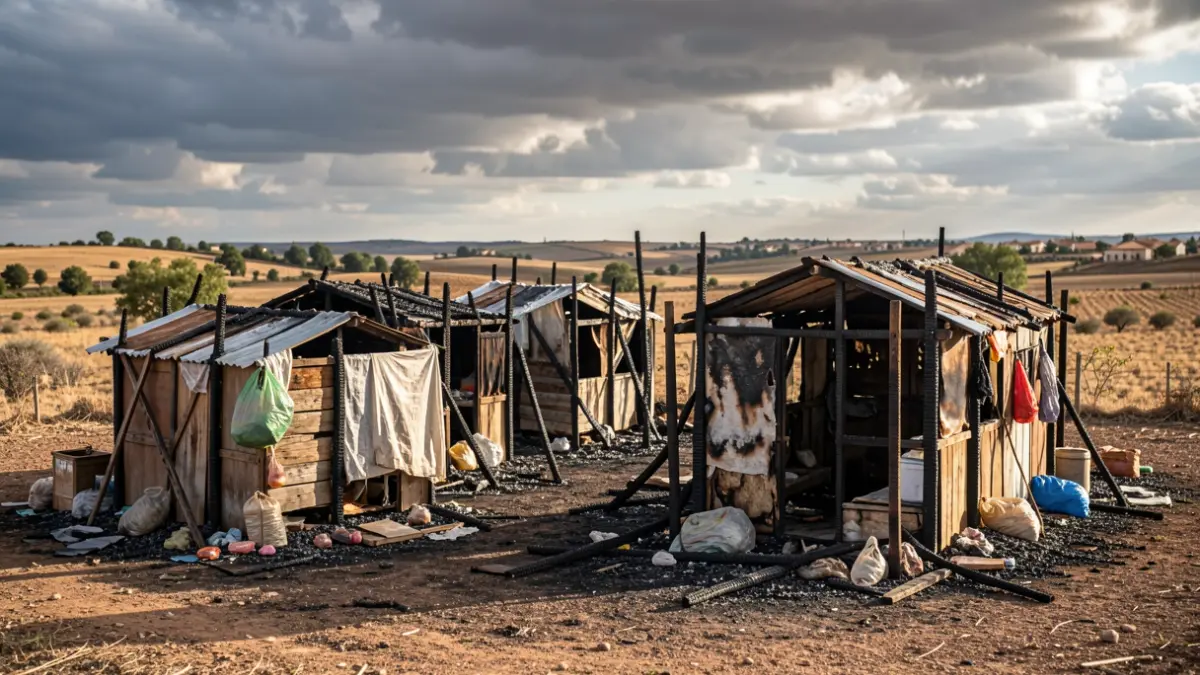
Recent fires in Palos de la Frontera and Cartaya have once again brought to the fore one of the chronic issues in the province of Huelva. The first incident, on Monday night, devastated a significant portion of the migrant worker settlement in the San Jorge industrial estate in Palos, leaving over 300 people with few belongings. The following day, another fire destroyed an agricultural shed and several modules used as housing for seasonal workers in Cartaya.
Fortunately, no personal injuries were reported in either incident. However, these events underscore a persistent reality in Huelva: thousands of agricultural workers live in extremely precarious conditions while supporting a key economic driver for the province. Images of shacks reduced to ashes are a recurring sight, with frequent fires in settlements like San Jorge (Palos), Lucena del Puerto, and Lepe.
The problem extends beyond fires, which are merely the most visible consequence of a complex phenomenon. This includes a lack of decent housing, high demand for agricultural labor, social exclusion, administrative hurdles, and a long-standing lack of coordinated action among authorities.
The province of Huelva leads Spain in red fruit production, requiring tens of thousands of workers each season. Despite origin-based hiring, the sector needs thousands more, many of whom end up residing in informal settlements primarily in Palos de la Frontera, Moguer, Lucena del Puerto, and Lepe. Recent data indicates nearly 3,000 people live in these settlements during the agricultural campaign, a figure that remains relatively stable. The Andalusian Association for Human Rights (APDHA) identifies major informal housing clusters in San Jorge (Palos), Las Madres (Moguer), El Bosque, Santa Lucía, and La Sevillana (Lucena), as well as various sites in Lepe.
These settlements are characterized by shacks made of pallets and plastic, lack of potable water, electricity, and sanitation, waste accumulation, and isolation. The APDHA deems these conditions incompatible with fundamental rights. The precarious nature of the constructions, combined with the use of flammable materials and improvised electrical systems or gas cylinders for cooking and heating, significantly increases the risk of fires, which have already claimed three lives in the province since 2019.
In 2020, the UN Special Rapporteur on extreme poverty, Philip Alston, described the conditions in Lepe as comparable to the worst he had witnessed globally. While some progress has been made, it remains insufficient. Lepe has seen significant advancements with its Comprehensive Plan for the Eradication of Shanty Towns, which includes demolitions, bans on new constructions, and housing alternatives. Shelters and residences have opened, but demand consistently outstrips supply, forcing many to sleep outdoors.
In other municipalities like Palos, Moguer, and Lucena, progress is slower. Social organizations report difficulties with residency registration and access to basic services. The Ministry of Housing has allocated five million euros for public housing for seasonal workers in Palos and Moguer, continuing previous investments.
Organizations such as the Fundación Savia and the Mesa Social del Agua de Andalucía have called for immediate action and coordinated strategies among administrations following the recent fires. They argue the problem extends beyond housing to social integration and administrative coordination, demanding sustained efforts in housing, residency registration, healthcare, transport, and employment.
The fires serve as a dramatic reminder of an often-invisible reality. Only when flames reduce shacks to ashes do settlements reappear in headlines, but the focus quickly fades, leaving a problem of over two decades unresolved.