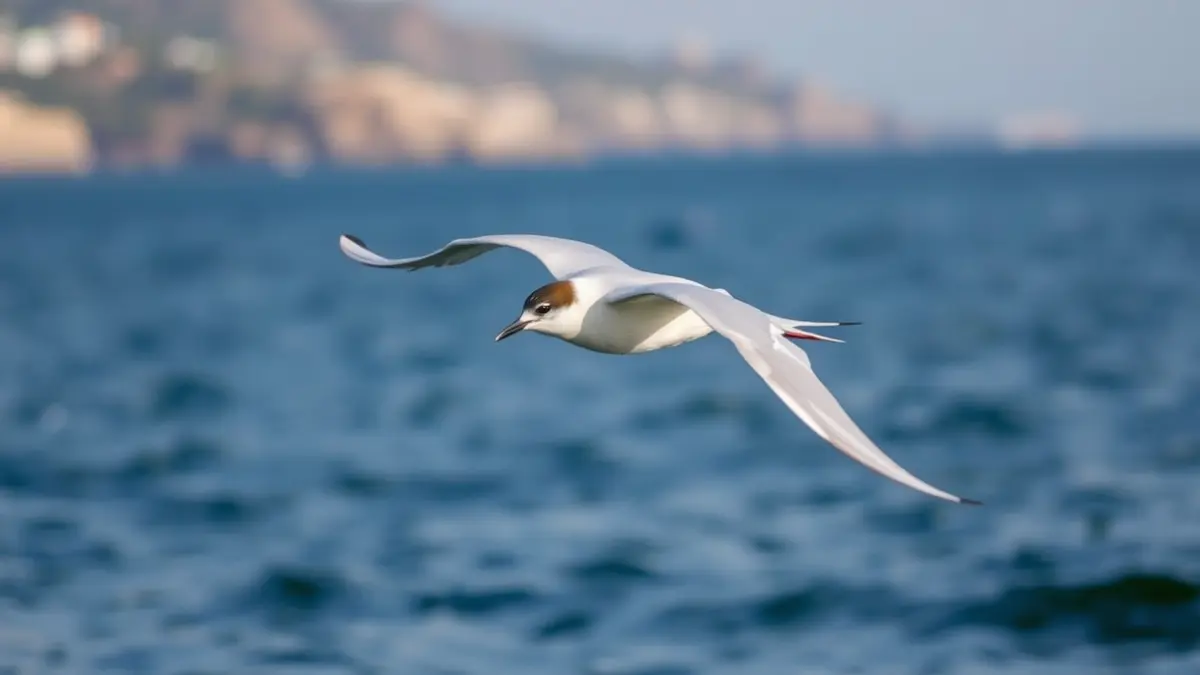
These birds, representing the rich biodiversity of the Granada coast, are a vital link in the migratory route between Europe and Africa. Their flight is characterized by deep, erratic wingbeats when searching for food, culminating in a masterful 'hovering' where they suspend themselves in the air before diving to catch their prey.
On the Granada coast, two main species can be observed: the common tern (Sterna hirundo) and the more abundant sandwich tern (Thalasseus sandvicensis). The sandwich tern is distinguished by its black legs, slender body, and a long, black beak with a yellow tip. Breeding adults display a black crest on the nape. It is a frequent winter resident, spotted on urban beaches, the Port of Motril, or breakwaters.
The smaller common tern has a black cap in summer and an intense red beak and legs, which darken in winter. Additionally, sporadic sightings of the little tern (Sternula albifrons), the smallest and most nervous of the family, and the rare lesser crested tern (Thalasseus bengalensis), recognizable by its carrot-colored beak, have been recorded.
These birds possess curious adaptations for their marine lifestyle, such as precise vision that corrects light refraction in water, a uropygial gland to waterproof their feathers, and salt glands that filter excess salt from seawater. Unlike gulls, terns feed exclusively on live fish, such as anchovies and young sardines.
The best places to observe terns on the Granada coast include the Port of Motril and the Azucarera del Guadalfeo, which serve as resting 'hotels'. The mouth of the Guadalfeo is a key feeding area, especially in colder months, while Cabo Sacratif is ideal for birdwatching during migratory passages. The Cliffs of Calahonda-Castell and Cerro Gordo also offer opportunities to see them fishing in open waters.
However, the future of these birds is threatened by overfishing, habitat alteration due to urban development and agriculture, pollution from spills and plastics, and rising sea levels. Their nests, made in holes in the sand, are particularly vulnerable to predators and competition from other species like the yellow-legged gull.