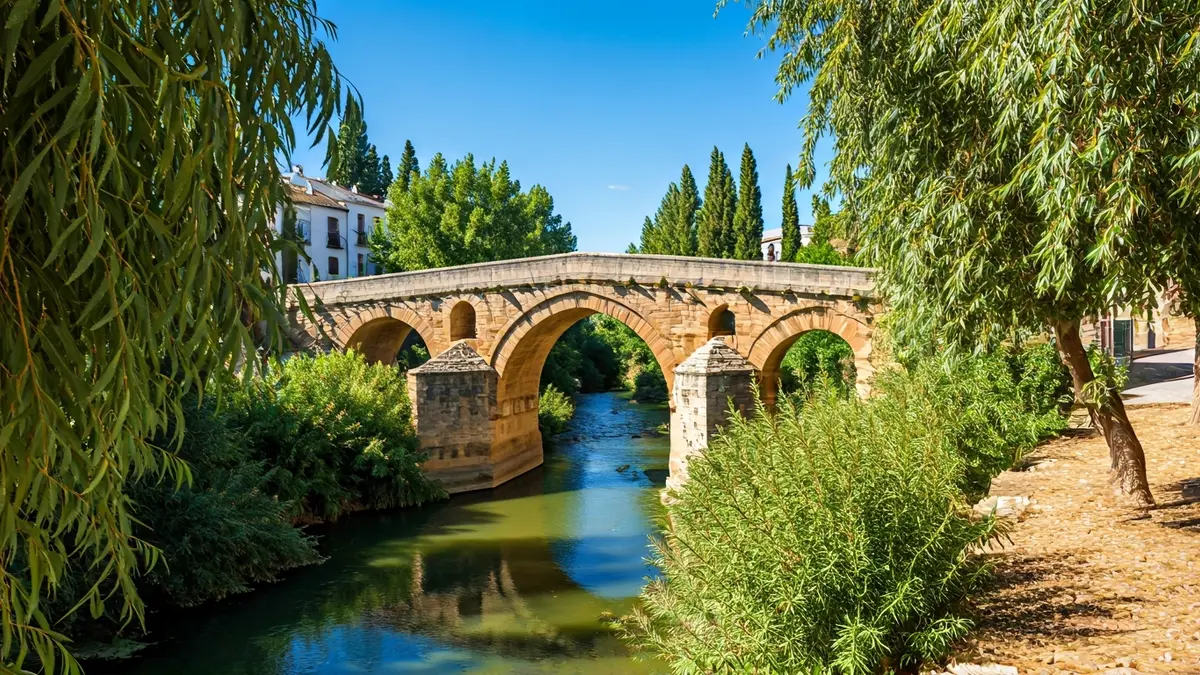
Approximately 50 kilometers east of the capital of Córdoba, in the Alto Guadalquivir region, lies Villa del Río, home to a structure that, while not a literal gate, has been named the 'Gate of Córdoba'. This metaphorical designation refers to the town's Roman Bridge, an imposing construction that spans the Salado stream, precisely on the provincial border.
Situated in a natural setting adorned with riparian flora and shaded by eucalyptus trees, this ancient bridge is a symbol of Villa del Río's identity and a testament to its artistic, architectural, historical, and cultural richness. Historians debate its origin, with some placing its construction during the reign of Emperor Augustus (27 BCE – 14 CE), while others date it to the Republican era, solidifying its status as a paradigm of Roman civil architecture.
Built with molinaza stone and ashlar masonry, the bridge stands out for the quality of its materials and its luxurious appearance, distinguishing it from other reconstructions with flat-faced ashlar. Declared a Site of Cultural Interest in 1931, its structure comprises four arches: a larger central one, two medium-sized ones on either side, and a smaller one to the right. There are indications of a fifth arch that was destroyed and closed over its two millennia of existence.
Throughout history, this passageway has undergone various repairs that have ensured its functionality. Until 1965, it bore the traffic of the old N-IV road. The Roman Bridge of Villa del Río is a unique monument, admired for its robust yet harmonious aesthetic, and has been a silent witness to the historical evolution of the region, given its strategic position on the Via Augusta, near the ancient Roman city of Ripa.