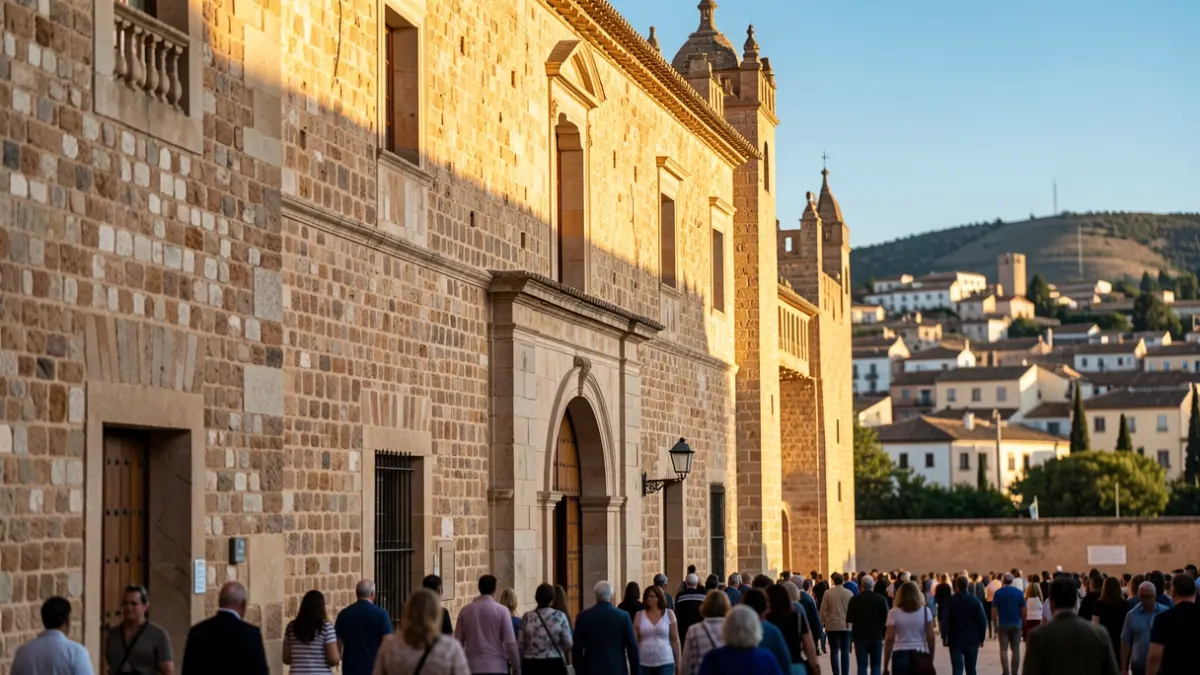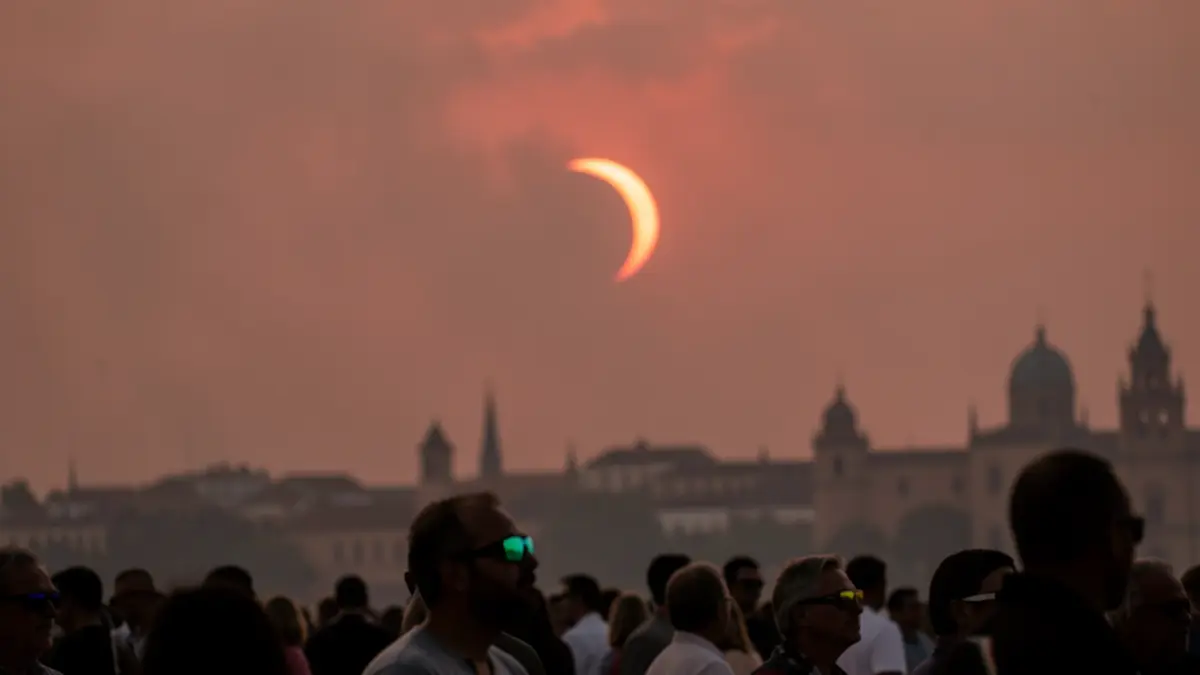
The afternoon of the past Wednesday in Córdoba was not an ordinary one. Despite high temperatures, which still registered 43 ºC in La Ribera at 19:00, thousands of Cordobans ventured out equipped with protective glasses to witness the solar eclipse. The horizon, darkened by smoke from a nearby fire and covered by high clouds, threatened to spoil the phenomenon, but instead, it filtered the light, creating a unique atmosphere.
From elevated and clear vantage points such as La Asomadilla, Miraflores, or the Balcón del Guadalquivir, citizens watched as the Moon began to obscure the Sun. Enthusiasm was palpable when, around 19:40, the Moon's "bite" out of the Sun became visible. Many prepared for the occasion with drinks, chairs, and blankets, aware of the event's uniqueness, which will not be repeated with such magnitude until January 2028 with an annular eclipse.
The obscuration in Córdoba was not total, but it was significant. As the eclipse progressed and the Sun descended towards the horizon, the light grew dimmer, shadows blurred, and colors lost intensity, creating a sensation of premature sunset. Animals, such as the nocturnal birds of the Sotos de la Albolafia, reacted to the unusual dimness, waking up earlier than usual.
José Estepa, a physicist, along with engineer friends, enjoyed the spectacle, seeking the exact point where the eclipse would align with the bell tower of the Mezquita Catedral. The eclipse's climax was reached at 20:36, after which the Moon began to recede, allowing the Sun to gradually regain its brightness.
This astronomical event is a prelude to a series of celestial appointments for the city. On August 2, 2027, another total solar eclipse is expected, which will be seen as partial in Córdoba. However, the main event will be on January 26, 2028, when the city will witness an annular eclipse, with the Moon obscuring approximately 82.7% of the solar disk for about 7 minutes and 12 seconds.
This consecutive "Iberian trilogy" of solar eclipses, along with several lunar eclipses scheduled between 2026 and 2028, makes these years an exceptional period for astronomical observation in Córdoba. The 2028 annular eclipse will allow for the observation of a brilliant ring of sunlight without the need to travel, a phenomenon not to be repeated in Spain until 2053.