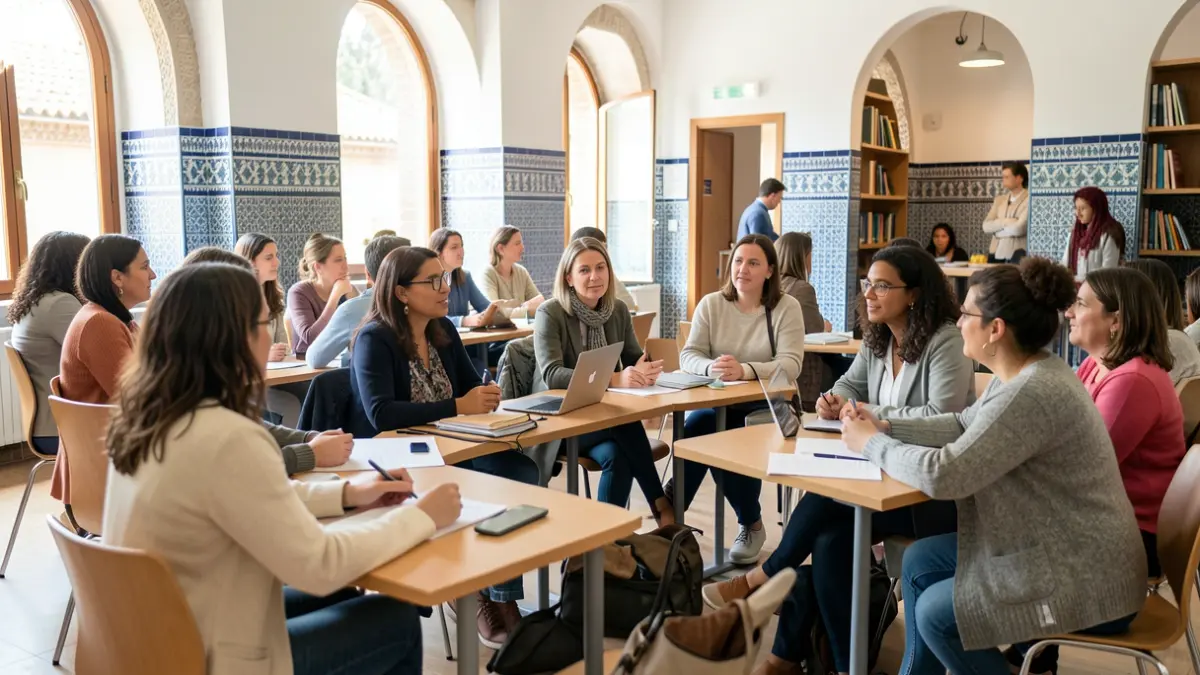
Another of the UAL's Summer Courses, titled ‘Almería, a benchmark in genetic improvement applied to production systems’, is progressing. The second day featured visits to the facilities of Enza-Zaden in El Ejido and the Andalusian Institute for Research and Agricultural, Fisheries, Food and Ecological Production Training (IFAPA) in La Mojonera. The first day took place at the headquarters of the Official College of Agricultural Technical Engineers of Almería.
The course directors, Juan Capel and Francisco Portero, have transformed the educational offering into a workshop. Both participated as speakers with the talk ‘Biotechnology and genetic improvement’. They were followed by professor Rafael Lozano with ‘Mutants, genes, and plant genetic improvement’, Rafael Fernández, a researcher from the CSIC at IHSM La Mayora of the University of Málaga, and José María Jiménez, a scientist from the Center for Plant Biotechnology and Genomics (CBGP) of the Polytechnic University of Madrid and the National Institute of Agricultural and Food Research and Technology (INIA).
José María Jiménez, whose career has focused on studying the genetic bases of plant evolution and domestication, highlighted the importance of identifying and characterizing key genes for crop adaptation. He acknowledged the University of Almería as a contact to follow, having participated in several editions of the course. His talk, ‘Genomics, gene editing, and plant improvement’, described the constructive environment and high academic level as “a pleasure”.
Jiménez stated that “regarding agriculture, the province of Almería is among the best in Spain, and also in agricultural research thanks to the UAL and the companies, which are at the forefront of innovation in crops and genetic techniques”. He emphasized that these innovations “have improved agriculture”.
The researcher focused on the “new techniques in genetics, molecular biology, and genomics for crop improvement, techniques that are currently advancing very rapidly”. He explained that “mass sequencing, which is very cheap”, allows for the study of crop diversity and its utilization, especially in traditional crops to understand their special characteristics.
He addressed the influence of domestication and the exploration of wild species to introduce desirable traits into existing crops. He expressed optimism about the challenge of feeding a growing population, noting that “there is much room for improvement” thanks to new technologies that enhance crop productivity and resistance to climate change.
Regarding climate change, he indicated that efforts are focused more on adapting to new conditions than on trying to halt it, although both actions are important. He stressed the need to explore new technologies, such as artificial intelligence, which facilitate the analysis of massive data, including genomic data.