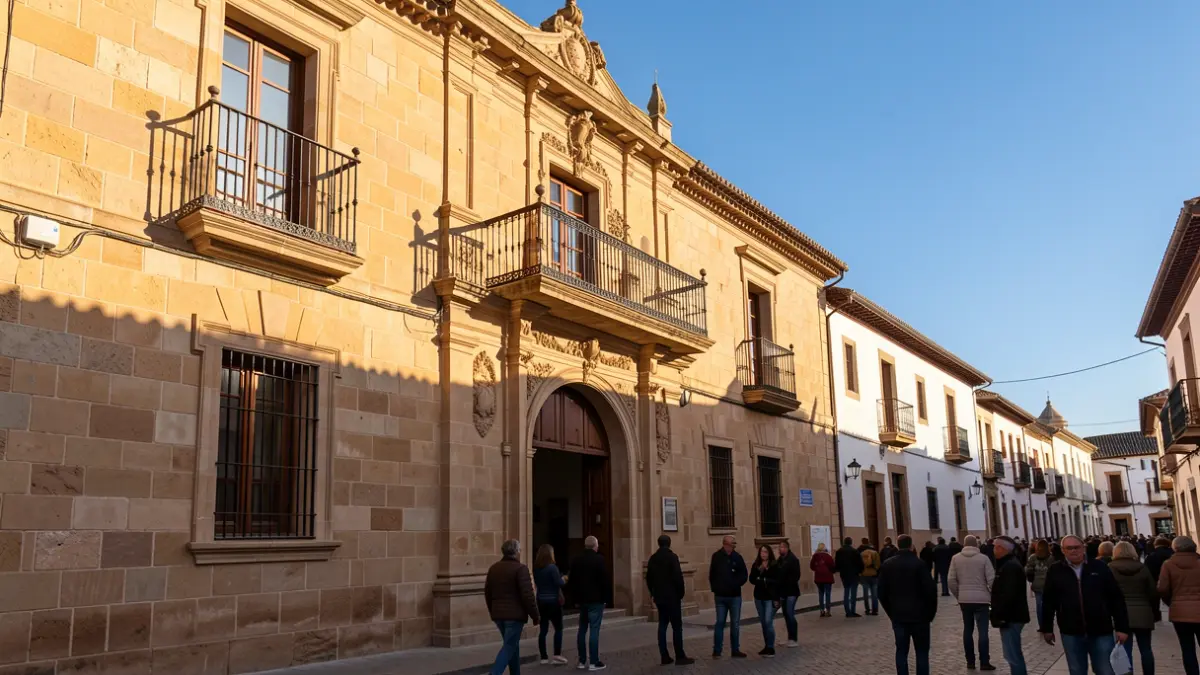
The municipality of Cuevas del Almanzora has remained true to its appointment with the UAL Summer Courses in its XXVII edition. The town, now a consolidated venue, offers its excellent infrastructure for the summer educational program, hosting two classic proposals. One is the workshop ‘Contemporary Illustration and Recovery of Traditional Techniques’, which utilizes the Sdun Museum-Workshop. The following week, the course ‘Cultural Manifestations in the Levante Almeriense’ will take place, with the Castle of the Marquis of Los Vélez, the archaeological site ‘El Argar’, and the Interpretation Center of the Argaric Culture as its locations.
The opening of the venue included an official inauguration by María del Mar Ruiz, Vice-Rector of Culture and Society, and the mayor of Cuevas del Almanzora, Antonio Fernández Liria. They were accompanied by the course directors: Adoración Sánchez ('Contemporary Illustration') and Antonio Llaguno ('Cultural Manifestations'). Antonio Alcaraz and Rafael Quirosa-Cheyrouze also participate in the direction.
María del Mar Ruiz emphasized the effort to “bring the University of Almería closer to the province” and the great reception of the illustration course, which is special for being able to use the Sdun Museum-Workshop. She thanked the town council for their predisposition to use these facilities and those of the Castle of the Marquis of Los Vélez. She highlighted that in the illustration course, the image “gains meaning and value in constructing and interpreting the story,” and regarding the second course, that the importance of cultural manifestations for regional development will be valued.
Antonio Fernández Liria stressed that Cuevas del Almanzora is “a consolidated pillar” in the provincial university map, recalling the town's long history with the Summer Courses. He stated that “knowledge and academia should not remain on the capital's campus” and that expanding throughout the territory is a “great success.” He mentioned that Cuevas has hosted high-level courses on archaeological heritage, regional history, mining, music, and contemporary art, allowing students to “immerse themselves in our living history.”
The mayor thanked the University of Almería for its trust and commitment to cultural decentralization, as well as the co-directors for their “extraordinary scientific and organizational effort.” He mentioned sponsors such as the company Deretil. Regarding the illustration course, he valued that it involves “stepping away from digital screens for a moment to get hands dirty with ink” at the Emilio Sdun Museum-Workshop. For the cultural manifestations course, he highlighted that it will focus on cultural management and the local identity of the region, analyzing everything from amateur theater to the roots of folklore.
Antonio Llaguno explained that his course aims to give identity to the towns of the Levante Almeriense, analyzing their identifying characteristics. This year, they will focus on cultural manifestations after the Franco era, the post-war period, the emergence of publishing houses, press magazines, historical heritage recovery, and cultural associations that have shaped the region's identity, to continue highlighting “what unites us all.”
Adoración Sánchez detailed that the course she co-directs recovers the “artist's book” and the “illustrated book,” where the original graphic work serves as a central axis. It will feature prominent speakers such as the publishing house ‘Media Vaca’, illustrator David Heras, and practical sessions at the Sdun Museum with Tita de Rêgo Silva and Antonio Alcaraz. The latter emphasized that this is the fourth consecutive year and highlighted the opportunity to work with the endangered technology of typography and movable type printing, as well as the high professional level of the students.