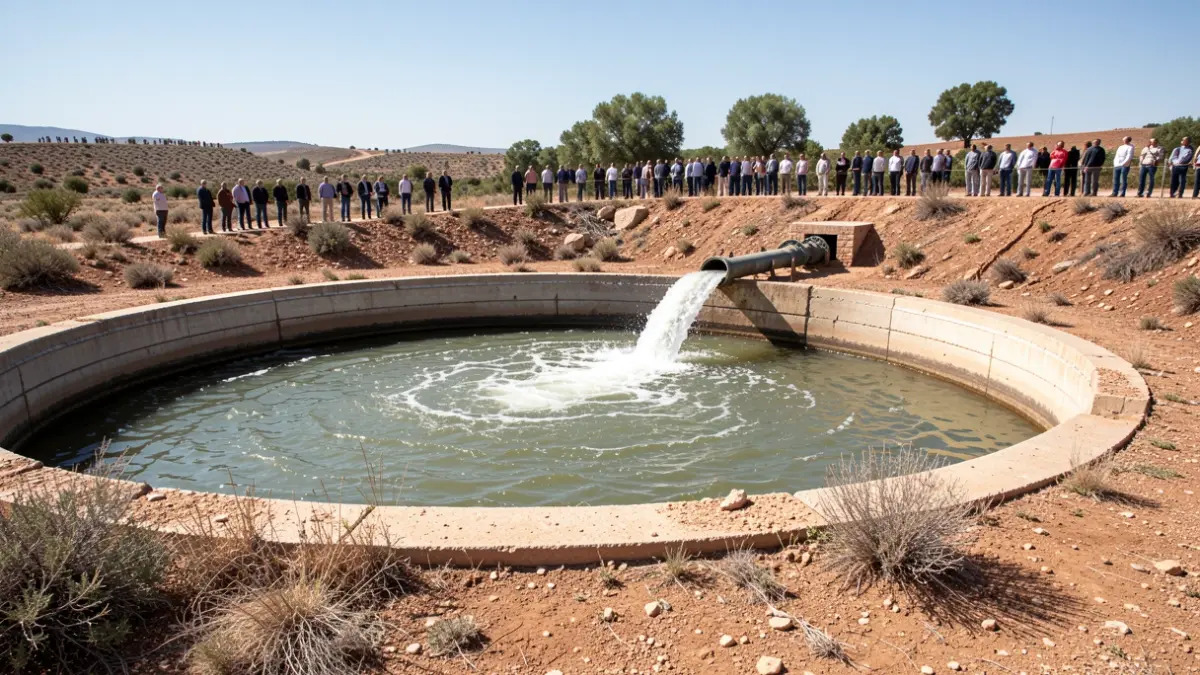
Reservoir 9, which will have the capacity to store one cubic hectometer of water, is fundamental to securing the future of the Campo de Níjar. This project will help overcome previous campaign's early-season water challenges and serve as a supply guarantee for the municipality. The infrastructure, funded and executed by the State Agrarian Infrastructure Company (SEIASA), started receiving water last Thursday, with a flow of over 500 liters per second to test its watertightness and prevent leaks.
Specialized technicians will review the machinery's operation and the sealing of welds in the coming days. Once tests are complete, the reservoir will store desalinated water for distribution during periods of high water demand. The president of CUCN, Antonio López, emphasized the reservoir's importance for the continuity of agricultural operations in the area, calling it "fundamental to ensuring our future."
López also thanked SEIASA for their involvement in realizing this project, especially given the difficulties arising from the maintenance of the Carboneras desalination plant. Despite water scarcity, the start of the campaign is expected to proceed without restrictions thanks to the stored water. Currently, daily consumption in Níjar exceeds the desalination plant's output, but available resources and reservoirs will help resolve the situation.
In addition to watertightness tests, CUCN plans to install roofs on Reservoirs 8, 9, and 10 to prevent evaporation, which causes the loss of over 600,000 m3 annually. These projects, which would feature the three largest roofs in Spain, will require additional funding. The lack of a water concession from the Regional Government of Andalusia (Junta de Andalucía) hinders access to certain aid, although discussions are underway with SEIASA and the Delegate for Agriculture, Aránzazu Martín, to find solutions.