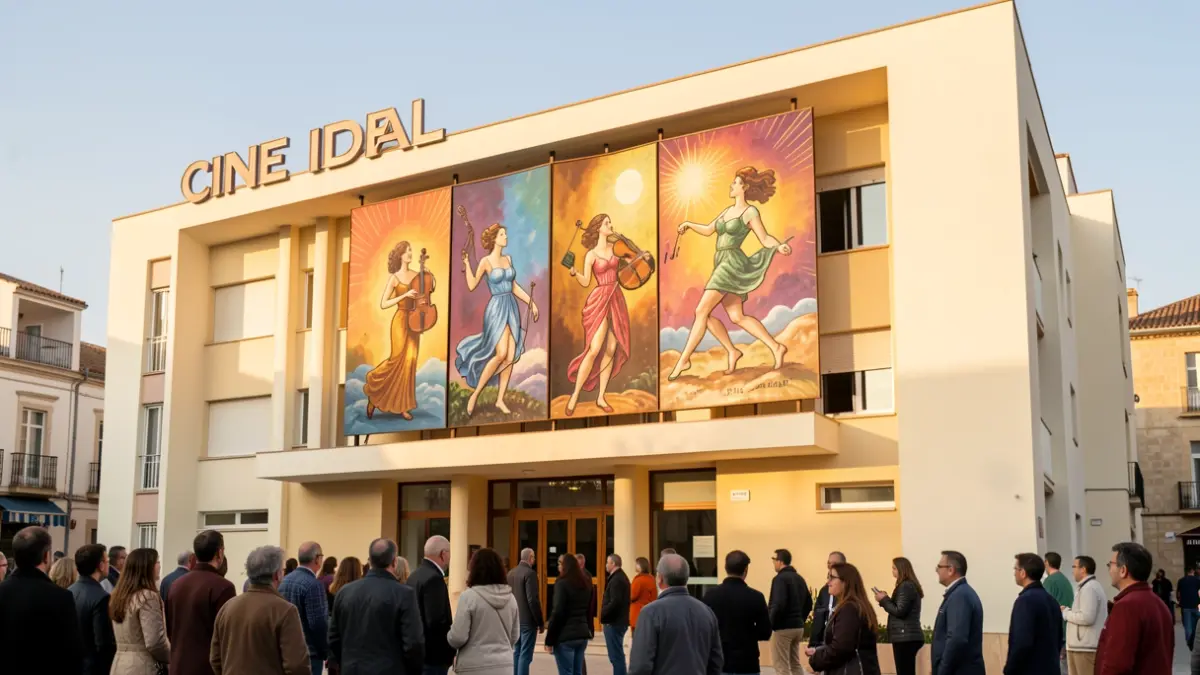
Since the beginning of July, a colorful triptych has adorned the main facade of the popular Cine Ideal in Baza, located on Calle Alamillos. The three paintings, created on metal sheeting, have been installed in the central spaces of the modernist facade, recently painted and refurbished by the City Council, the building's owner.
The works, known as “Las Ideales”, are three pictorial allegories representing Music, Light, and Movement, three fundamental elements of cinema. Each allegory is personified by a woman dressed in different attire and surrounded by settings and elements that include nods to the city of Baza. They were conceived by siblings Agustín and Celia Tello and executed by Celia Tello at her establishment “La íbera · Escuela creativa de Artes Plásticas” between April and July of this year.
Beneath the first figure, “Music invokes the invisible”, an African-looking woman is depicted playing an instrument similar to a bandurria. The second allegory, “Light reveals the absent”, shows a woman with adornments inspired by the Dama de Baza, between columns evoking the Church of Dolores and with the Jabalcón hill in the background. The third, “Movement writes time”, features a woman holding the Cascamorras flag, alluding to theater, sports, and sculpture.
The mayor of Baza, Pedro J. Ramos, highlighted during the inauguration that the artwork is a tribute to the Cine Ideal and the city, created by local artist Celia Tello, and that it enhances this central cultural hub.
Celia Tello explained that the works, conceived with her brother Agustín, aim to dialogue about the city and cinematic elements. The allegory of Music includes references to migration, the ‘Velasco Villegas’ lute orchestra, ‘Dama de Baza’ guitars, castanets, and the Arab Baths of Baza. The allegory of Light is inspired by the Dama de Baza, the Church of Dolores, Jabalcón hill, and local produce, as well as paying tribute to Luz, Piedad, Francisco, and Manuel and the photographic collective COBAF.
Finally, the allegory of Movement includes references to classical theater, the Dengra Theater, cyclist David Valero, and the wood carving work of Hijos de Esteban Jiménez, with the figure dancing among windmills and carrying the Cascamorras flag.