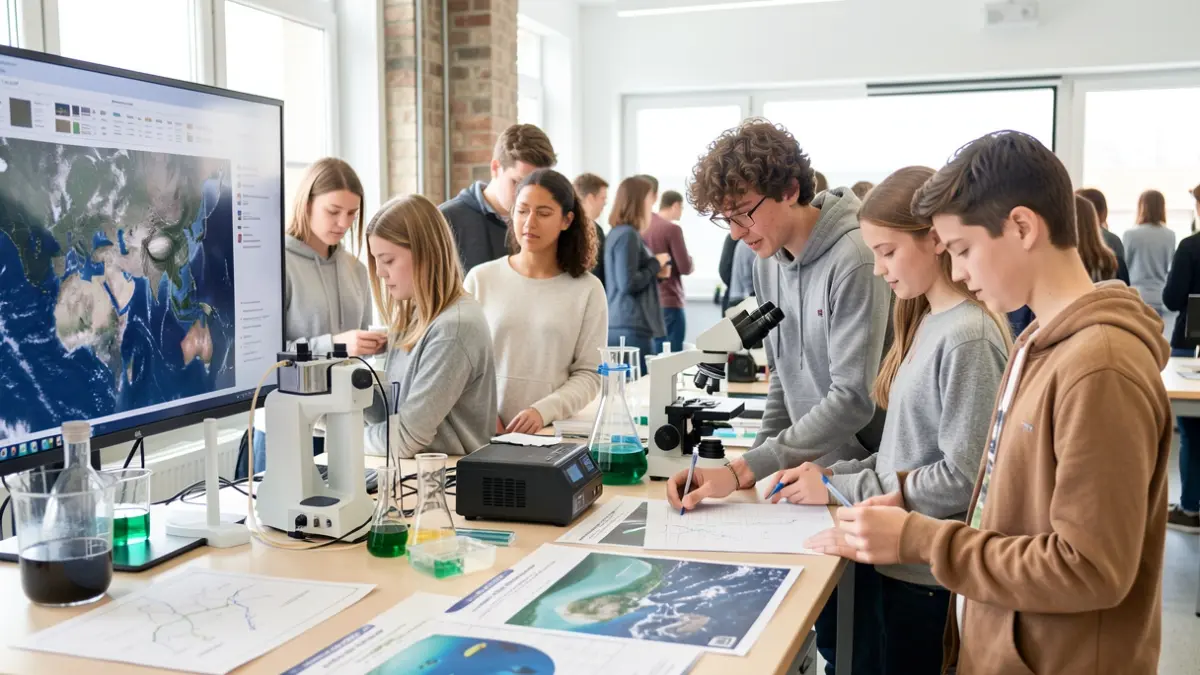
The mayor of Chiclana, José María Román, along with municipal delegates for Education and Youth, María José Batista and Fede Díaz, welcomed students from the IES Ciudad de Hércules. The institution has earned the 'Blue School' certification from the European Commission under the EU4Ocean Coalition, aiming to empower teachers and students as active agents in safeguarding marine ecosystems.
This achievement is the result of a project by a group of 4th-year ESO students. Through their Scientific Culture class, they spent part of the academic year analyzing satellite imagery from the European Space Agency (ESA), examining marine salt samples, handling scientific data, and studying the evolution of the waters in the Gulf of Cadiz.
The mayor highlighted the school's work on climate change and microplastics, noting that "the increase in water temperature is causing changes in our coastline, with the arrival of algae and fish from warmer regions."
“"Microplastics enter our bodies through salt and fish. We found that the salt from our salt pans has 10 percent more microplastics than the salt we buy in the supermarket."
Student Ángela Ramírez explained that while the body eliminates most ingested microplastics, some remain, potentially affecting fetal growth in pregnant women. The students have collected plastics from Chiclana's salt pans and marshes and proposed the creation of 'plastic cages' along the coast, as well as a possible relocation of the Tuesday market.
The authors of the research 'Climate change, acidification, and oceanic pollution by microplastics in the Gulf of Cadiz', under the guidance of Marta Capdevila, are Daniel Álvarez, Marcos Benavides, Ana Dori Cabeza de Vaca, Elena García Lobato, José Miguel Martínez, Natalia Miralles, José Antonio Morales, Laura Morilla, Héctor Ortega, Julia Quintana, Ángela Ramírez, José Ramos, Francisco Javier Reyes, Julia Rodríguez, Marco Ruiz, and Roberto Vázquez.
This investigation quantifies two major environmental challenges: climate change and microplastic pollution. They have documented phenomena such as rising sea surface temperatures in the Gulf of Cadiz, progressive ocean acidification, and the presence of microplastics in both the marine environment and everyday products like salt.