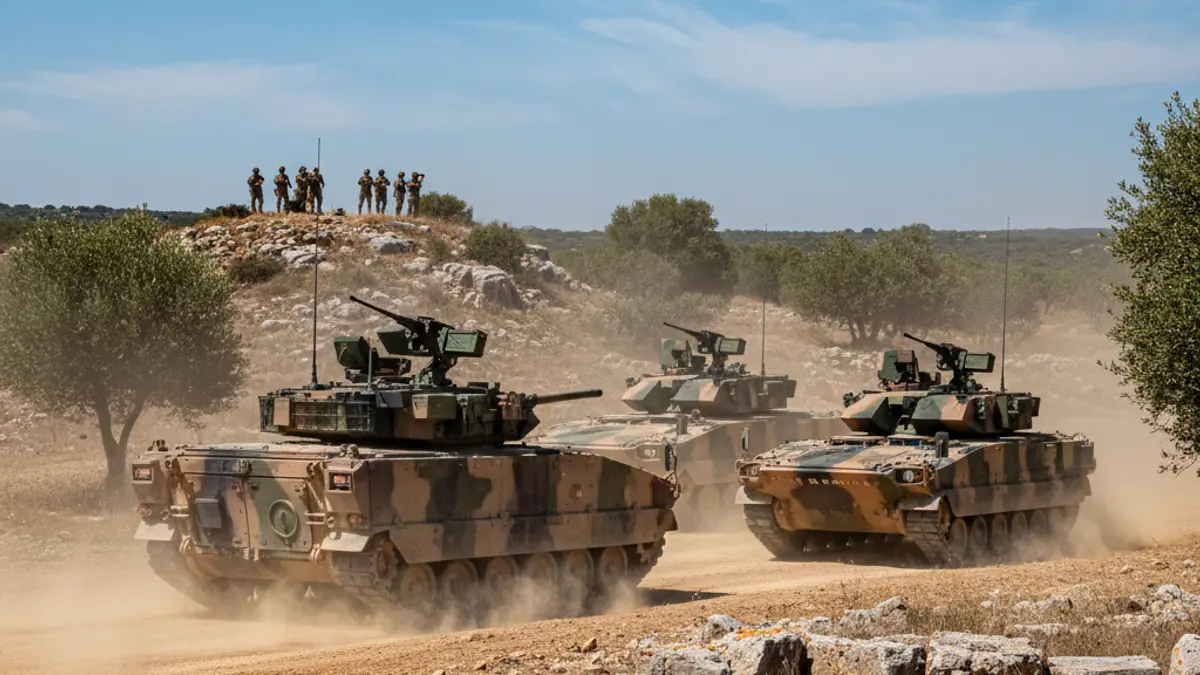
During the first week of March, the “Álvarez de Sotomayor” Maneuver and Firing Range, in Viator, was the setting for the tactical exercise “Morro Nuevo”. These maneuvers, carried out by the 1st Company of the VII “Valenzuela” Flag of the 3rd “Don Juan de Austria” Tercio, are part of the Annual Preparation Plan “Valenzuela 2026” and are associated with the TIER1 maximum operational demanding level.
The Spanish Army has highlighted that these tests not only served for conventional tactical training but also to evaluate new vehicles and systems that are transforming frontline operations. Among the innovations tested are the VAMTAC platform, the Guardian remote weapon stations, and the Alano autonomous vehicle, designed for evacuations and logistical support in high-risk areas.
The exercise simulated complex operations in an environment that included open areas, mandatory passages, and dispersed urban centers, anticipating a scenario where the Army might face a “technologically advanced enemy” employing hybrid strategies. The introduction of the Guardian 1.5 and 2.0 towers, remote weapon stations, allows firing from inside the vehicle, protecting the gunner. These towers incorporate thermal cameras, long-range daytime vision systems, laser rangefinders, and automatic target tracking.
“"Before, the gunner was exposed, and now they are inside the vehicle, sheltered from the enemy."
The Guardian 1.5 version is compatible with calibers from 5.56 to 12.70 millimeters, can integrate smoke grenade launchers, and remains stabilized on two axes for firing on the move. The Guardian 2.0, meanwhile, can mount 40-millimeter MK-19 grenade launchers and even high-rate-of-fire configurations oriented towards anti-drone functions. These remote stations can be installed on vehicles such as the VAMTAC, BMR, and even the Dragon 8x8 armored vehicle, a key modernization program for the Spanish Army.
Another innovative element tested was the Alano vehicle, an autonomous system designed to reduce personnel exposure in logistical support and medical evacuation tasks. This vehicle can transport wounded, ammunition, or supplies to risk areas without needing to send more soldiers. It is operated by remote control with a range of 500 meters and features a hybrid diesel-electric system for extended autonomy.
“"With this vehicle, we avoid having to involve people who shouldn't be involved."
These tests align with the guidelines of the Spanish Army through the Future Force Center and the “Force 35” project, which seek the digitalization and robotization of brigades. The goal is to “deploy robots first and preserve human life,” according to a military official. The conclusions of the “Morro Nuevo” exercise will be incorporated into the Army's “lessons learned” system for future development phases, reaffirming that “technology is a fundamental part of action, and these vehicles are gaining increasing importance.”