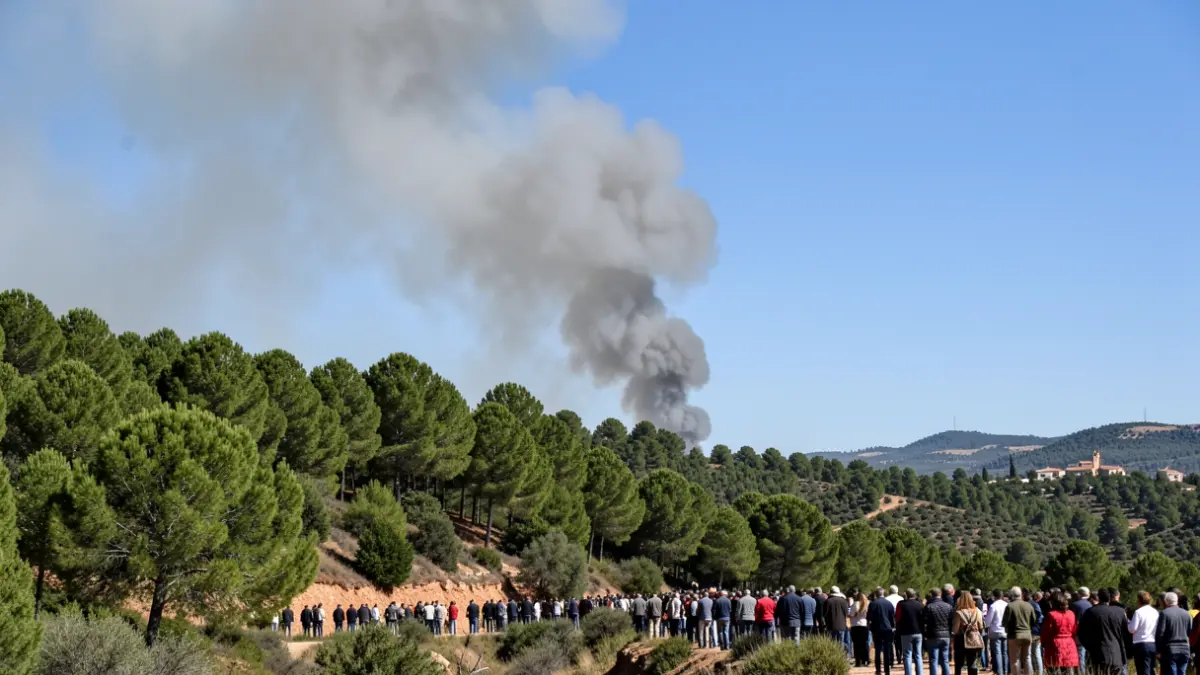
The complex fire, one of the most devastating in Andalusia in recent years, began on August 6th in the Raboconejo area, within the municipality of Niebla (Huelva). After rapid initial spread, the fire has now surpassed 31,000 hectares and a 120-kilometer perimeter, impacting two provinces. The main threat is now concentrated in the Pata del Caballo area and in Aznalcóllar (Seville).
Evacuations, initially in Huelva municipalities like El Madroño and Berrocal, have extended to scattered areas of Estacena del Campo and Aznalcóllar, affecting over 800 residents. The firefighting deployment is one of the largest in the region, involving Infoca Plan, UME, the Ministry of Ecological Transition, provincial consortia, and the Guardia Civil, with over 800 professionals and 26 aerial resources.
The fire's behavior, influenced by convective phenomena, secondary ignitions, and wind shifts, has led to it being declared "beyond extinction capacity." The Minister of Presidency, Antonio Sanz, summarized the complexity: "We have had up to seven different fires in one, sometimes with jumps against the wind direction."
Efforts have focused on preventing fatalities, protecting urban centers, and containing the flames' advance. Despite containment progress in Huelva, the situation remains challenging due to low humidity and ground heat, which can fuel new spread.
In the province of Seville, the Pata del Caballo area and the municipality of Aznalcóllar have become the main focus. Preventive evacuations have occurred, and livestock has been relocated. The mayor of Aznalcóllar, Juan José Fernández, has urged calm, stating there is no immediate danger to the town, although smoke and ash are affecting the population.
The municipality of El Madroño and its hamlets have also been affected, with residents rehoused in El Castillo de Las Guardas. The fire's progression in Pata del Caballo, an area of significant environmental value previously ravaged two decades ago, is key to determining its future scope.