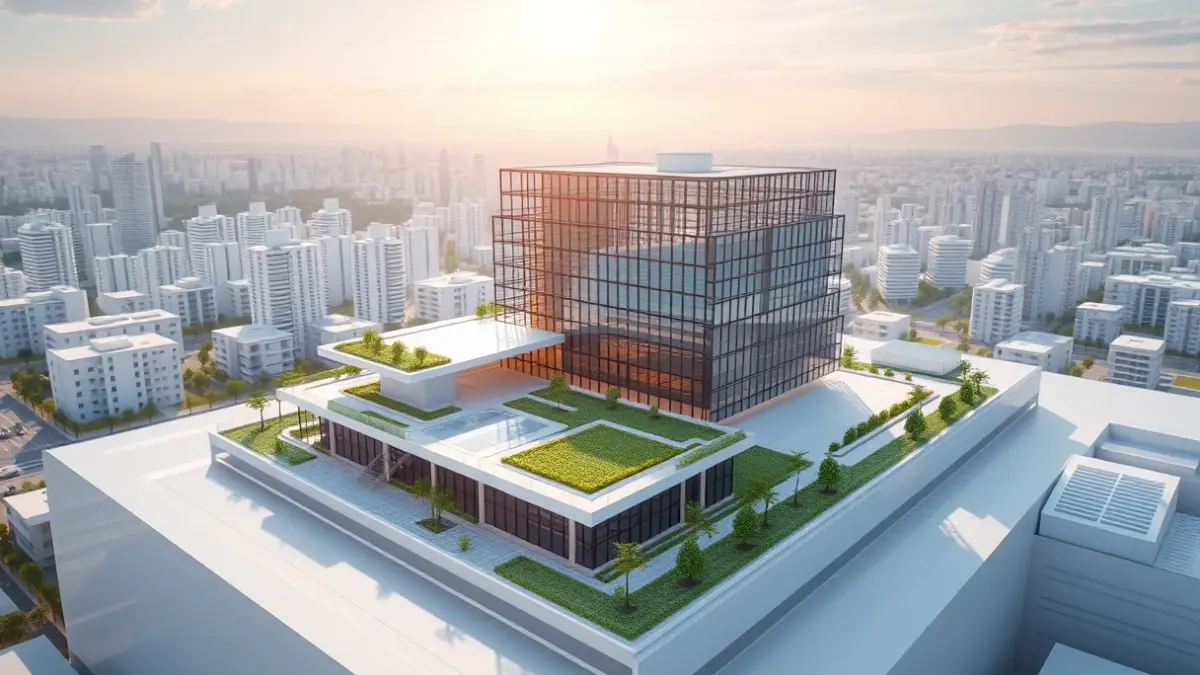
The construction sector in Seville is moving towards an increasingly digital, efficient, and sustainable model, in line with major European trends transforming building. This progress is evident in the development of Smart Cities, the BIM (Building Information Modeling) methodology, the Passive House standard, and industrialized construction.
The city is already applying these technologies in real projects that are redefining how urban infrastructure is planned and executed. A prominent example is eCitySeville, on Isla de la Cartuja, which acts as an urban laboratory for the transition to a decarbonized environment. This project promotes the use of renewable energies, smart buildings, and advanced energy management systems.
The BIM methodology has consolidated as a key tool in the sector's transformation in Seville, thanks to its ability to centralize all construction information into a digital model. This fosters more efficient decision-making, greater coordination, and a significant reduction in errors, deadlines, and cost overruns throughout the project's lifecycle.
“"The BIM methodology has the capacity to centralize all construction information (geometric, time, costs, environmental, and maintenance) into a digital model developed by all its agents."
Among the most relevant projects in Seville using BIM are the SE-40 viaduct over the Guadalquivir River, Metro de Sevilla's Line 3 North, and the Proton Therapy Center at the former Military Hospital. At the municipal level, the Seville City Council also applies it in interventions such as the rehabilitation of the Mercado de Feria and the improvement of the Mercado de Triana.
The Passivhaus standard, or passive house, is gaining ground in Seville, especially in single-family homes and renovations. Its goal is to minimize energy consumption through advanced thermal insulation and mechanical ventilation with heat recovery, which is highly effective in Seville's climate for ensuring indoor comfort with reduced energy consumption.
Industrialized construction is also growing in the province of Seville as an alternative to the traditional model. This approach, which involves manufacturing elements or modules in a controlled environment for later on-site assembly, allows for reduced deadlines, improved quality, and increased efficiency. Companies like CIMPRA in Utrera and Arquitectura Industrializada Andaluza SL in the capital are examples of this trend.
The combination of these innovations is driving a structural change in Seville's construction sector, shaping a new urban model that is more sustainable and adapted to climatic and social challenges. The city is thus positioned as a key territory in the transition towards more innovative construction, where technology and sustainability are already part of the present.