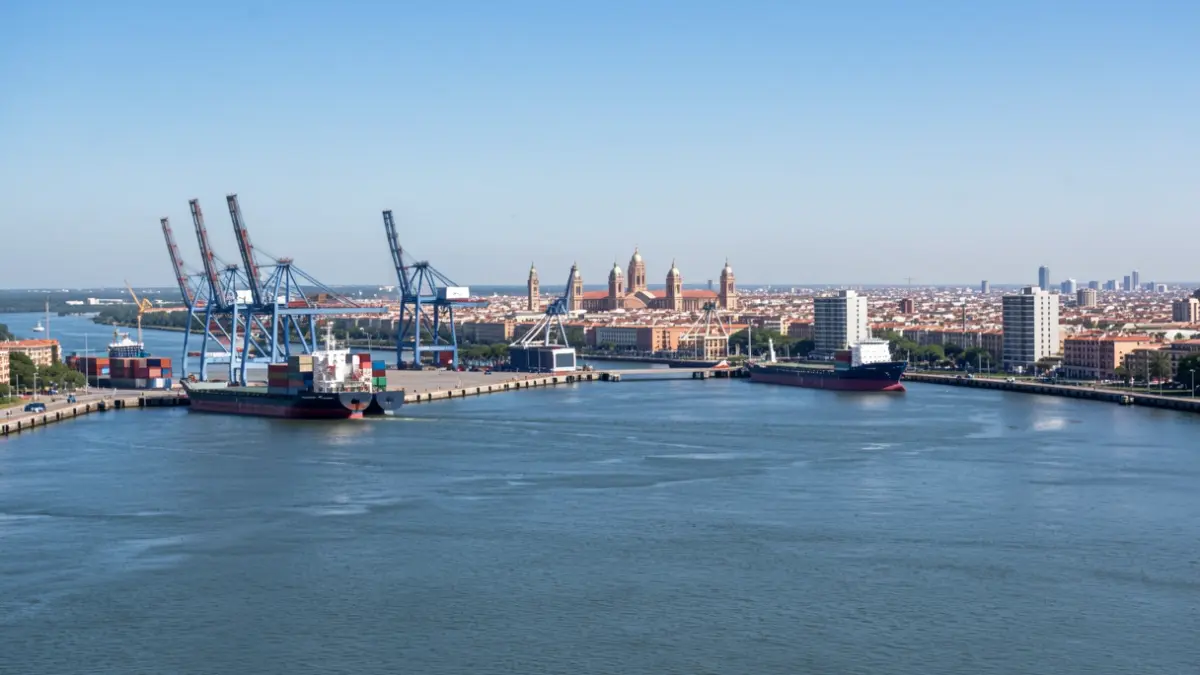
Last April marked the centenary of the completion of one of the most significant transformations in the history of the Port of Seville: the opening of the Tablada cut. This ambitious project, conceived in 1903 and inaugurated on April 6, 1926, benefited from the decisive contribution of engineer Luis Moliní Ulibarri. His work redefined the relationship between the city and the river, consolidating Seville as an inland maritime port and laying the groundwork for the contemporary port and urban expansion southward.
Luis Moliní, born in 1848 in Requena (Valencia), arrived in Seville in 1895 after directing major works in the ports of Málaga, Huelva, and Almería. Upon taking charge of the Sevillian port, he faced considerable challenges: navigation problems due to meanders and sandy shoals, insufficient docks for growing traffic, and the Sanlúcar bar as a primary obstacle due to its shallow draft. Despite being the eighth largest Spanish port by tonnage, Seville's port required modernization to meet logistical demands.
Moliní prioritized navigability, promoting the protection of riverbanks and the acquisition of advanced dredgers for channelization. These improvements allowed for the loading of larger vessels, previously unimaginable. His in-depth study of the Sanlúcar bar was crucial, leading to dredging and improved access to the estuary, in addition to implementing a buoyage system that represented a technical advancement for navigation safety and the modernization of river communications.
Moliní's masterpiece was the 'General Project for the Improvement of Navigation of the Bar, the Estuary, and the Port of Seville' (1903). This plan systematized data on the river's behavior and outlined the main strategies for the port's development in the 20th century. Within this project, the Tablada cut, a new artificial channel, eliminated the Los Gordales meander, reducing travel distances and facilitating tidal access. This intervention transformed the fluvial geography, shifting port activity southward and proving vital for urban development linked to the 1929 Ibero-American Exposition.
Despite considerable technical and economic difficulties (equivalent to approximately 875 million euros today), Moliní initiated the work with great determination. In 1915, he reached the mandatory retirement age but the project continued under the direction of José Delgado Brackenbury. The Port Works Board requested his continued involvement as an administrative delegate, a role from which he actively participated in managing tariffs and financing works.
Luis Moliní passed away in Seville in 1923, just three years before the official inauguration of the projects he had conceived. The city partially recognized his contribution by naming the Moliní avenue, near the Alfonso XIII bridge, in his honor. However, his figure remains relatively unknown outside technical and historical circles, despite being one of the main architects of contemporary port Seville. His legacy overcame centuries of navigation difficulties and ushered in a new economic era for the city. It is proposed to rename the current North Dock of the Batán basin as 'Engineer Luis Moliní Dock' to perpetuate the memory of the man who forever transformed Seville's port and river.