The capture of Muslim Seville, a pivotal moment in the Reconquista, was a major land operation, but its success was fundamentally dependent on a complex naval campaign. This historical episode is recognized as the true origin of the Castilian navy, where Fernando III relied decisively on the organizational and tactical capabilities of Ramón Bonifaz, whose actions on the Guadalquivir River altered the course of the war.
This endeavor began on the Cantabrian coast. Bonifaz, an experienced sailor, merchant, and mayor of Burgos, was vested with royal authority to mobilize shipowners and sailors. His call resonated particularly in the so-called Four Coastal Towns: Laredo, Castro Urdiales, Santander, and San Vicente de la Barquera. The swift response from these ports allowed for the rapid assembly of a considerable naval force, which was further strengthened by the addition of new ships and crews from Galicia during its journey south.
The resulting fleet was remarkably substantial for its time: thirteen sailing vessels, supplemented by five galleys specifically built by the Crown's initiative in Cantabrian shipyards throughout 1247. This combination of transport and combat vessels provided Bonifaz with a flexible tool, capable of adapting to both oceanic navigation and the demands of riverine combat. By early August of that same year, the squadron reached the mouth of the Guadalquivir.
There, the first major engagement of the campaign took place: the Battle of Bonanza. Off the forests of Doñana, the Castilian fleet confronted Muslim saetías and zabras, which, under the command of Abu Qabl, sought to prevent their access to the river and protect supply routes to Seville from North Africa. Bonifaz's victory not only cleared the estuary but also destroyed the city's main naval support.
From that point, the campaign evolved into a river war. Bonifaz sailed up the Guadalquivir while Fernando III, positioned in Alcalá del Río, supported the operation by sending contingents to prevent Muslim forces from harassing the fleet from land. In the following months, between San Juan de Aznalfarache and the Torre del Oro, battles, skirmishes, and attrition actions ensued, where coordination between cavalry and ships proved essential.
The progressive control of the river allowed the Castilians to consolidate strategic positions. This facilitated the passage of troops to the right bank (Gelves and San Juan de Aznalfarache), making it possible to attack the fortified suburb of Triana. Simultaneously, covering forces were established to prevent the arrival of aid sent by the king of Niebla. Thus, Seville became increasingly isolated, though it still retained a vital route: the pontoon bridge connecting it to Triana.
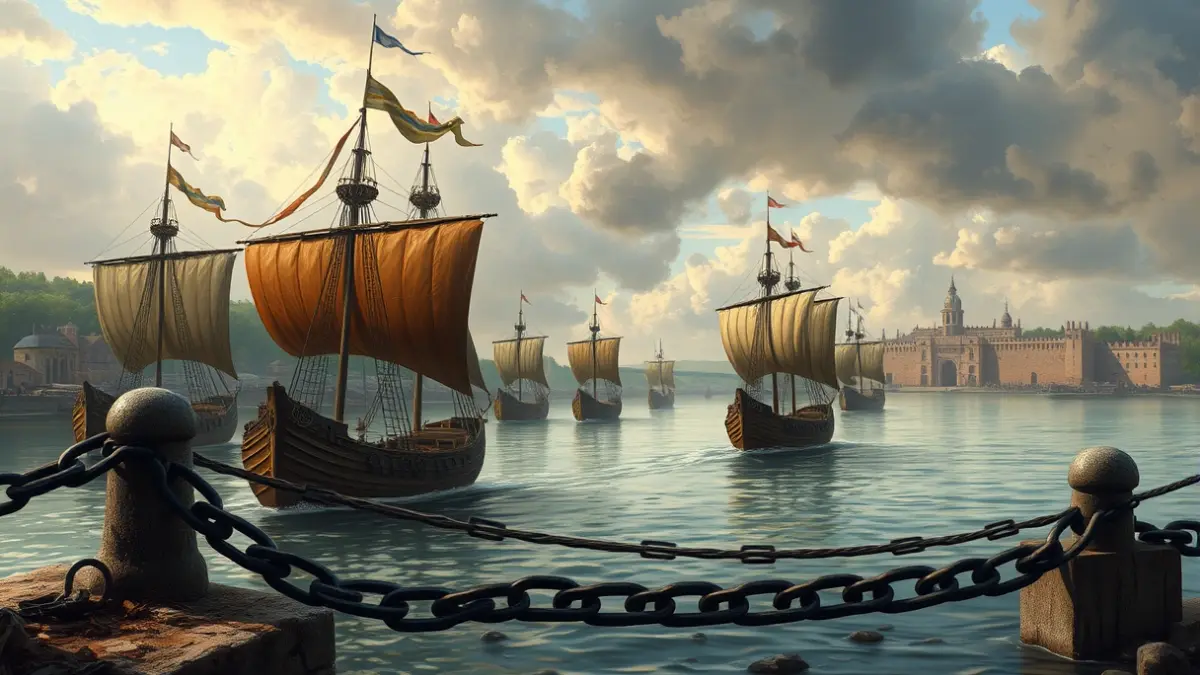
This infrastructure represented the main obstacle to complete river domination. Chronicles describe it as being formed by boats linked by thick chains, which aligns with the legend that the famous “chain of the Torre del Oro” was not an isolated element, but part of the framework that held the bridge-barrier together. Rather than merely cutting a single chain, Bonifaz's objective was to dismantle this entire floating structure that ensured the city's supply. Therefore, the breakthrough operation was carefully planned, with the chosen moment being May 3, 1248: the feast of the Invention of the Holy Cross.
Bonifaz then prepared his two most robust ships, the Rosa de Castro and the Cerceña, likely large cargo carracks, reinforcing their bows with thick planks secured by bolts, as well as their masts, aware of the violent impact they would have to withstand. When the tide rose and the wind blew favorably, the ships launched at full sail against the bridge from San Juan. The first collision shook the structure; the second, led by Bonifaz's own ship, definitively broke the chain and mooring connections, dismantling the pontoon bridge.
The consequence was immediate. Seville was deprived of its main supply route to the Aljarafe, and although a general assault on the city and Triana castle was attempted, it was repelled. However, Muslim resistance was already mortally wounded. Without the possibility of receiving reinforcements or supplies, the situation became untenable. The Christian forces perfected the siege, neutralized enemy navigation, and consolidated their control of the river.
Finally, on November 23, 1248, the Muslim leader Axataf surrendered to Fernando III. Contemporary chronicles acknowledge that the breaking of the bridge constituted the entire victory, as from that moment the defenders understood that defeat was inevitable. The Guadalquivir, which had protected Seville for months, became the instrument of its downfall.
The symbolic impact of this episode was profound and lasting. Bonifaz's feat was reflected in the coats of arms of various northern cities, such as Santander —where a ship breaking chains next to the Torre del Oro appears— as well as those of Laredo, Santoña, Comillas, and Avilés. These emblems not only commemorate a victory but also testify to the crucial participation of Cantabrian sailors in an undertaking that changed the history of the Reconquista.
On the Guadalquivir, a new strategic dimension was born for Castile: the awareness that control of water could decide the fate of cities and kingdoms. This idea, over the centuries, would crystallize in the formation of the Spanish Armada and still symbolically endures today in modern projects such as the new class of Bonifaz frigates, a contemporary evocation of that initial naval impulse born in the Andalusian waters.