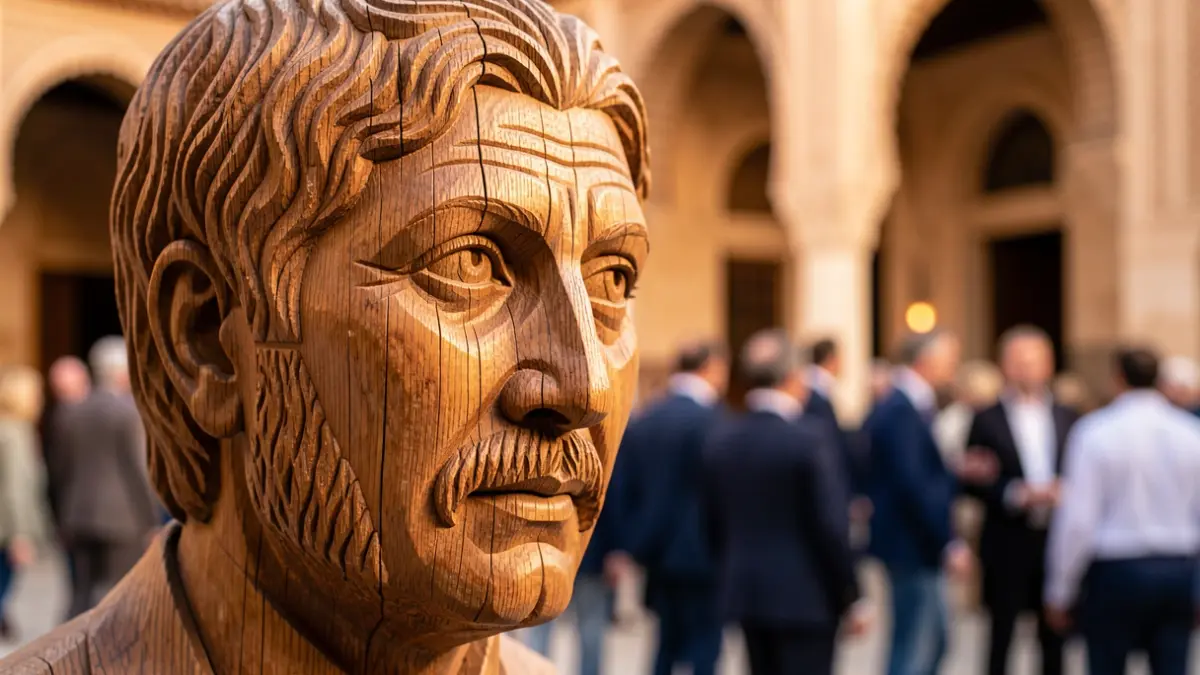
Jesús Devesa Molina, known for his connection to Holy Week and Cadiz culture, as well as his work in media and television programs, delves into historical fiction with his work 'El escultor de almas' (The Sculptor of Souls). The book revives the figure of Francisco Antonio Ruiz Gijón, the Sevillian imaginer who shaped the Santísimo Cristo de la Expiración (Most Holy Christ of Expiration).
The need to tell Ruiz Gijón's life story arose during the pandemic, driven by the curiosity to explore the legend of 'El Cachorro' beyond what was commonly known. Devesa Molina, who also served as the herald for Cádiz Holy Week in 2016, sought to give literary life to this fascinating character, whose story became a biographical novel of nearly four hundred pages.
The author considers Ruiz Gijón a 'greatly forgotten' figure of Baroque art, whose talent was diminished by personal circumstances such as the early death of his father, an impossible love, and the loss of his first daughter. Despite these difficulties, his work managed to restore him to a prominent place in art history.
Devesa Molina describes how, upon studying Ruiz Gijón's work, he discovered the 'true dimension of the character,' attempting to translate into literature the expression in the eyes of 'El Cachorro,' which he describes as 'pure literature'.
The novel aims to do justice to Ruiz Gijón's memory, presenting not only the artist behind awe-inspiring images but also the man marked by the losses and contradictions of his time. The author emphasizes the importance of understanding the man to understand the artist.
The title 'The Sculptor of Souls' stems from the profound impression left by Ruiz Gijón's works, which seem to contain 'something more' than mere representation. The author points out that the masterpiece, the Christ of Expiration, known as 'El Cachorro,' might hold the soul of Martín Vargas, the Romani man from Triana who gave it its nickname.
The most surprising aspect of Ruiz Gijón's life, according to Devesa Molina, was his ability to continue creating despite an irregular life trajectory, marked by indiscipline and personal crises, yet he never stopped receiving commissions.
The writer tackles the challenge of bringing a well-known legend, like that of 'El Cachorro,' to life with respect for tradition and devotees. The novel is presented as a 'literary game with history,' combining historical data with imagination and fiction to engage with the legend.
Ruiz Gijón's forward-thinking vision is highlighted, comparing his formal audacity to artists like Bernini, Picasso, or Dalí. Works such as the float of Gran Poder or the Divine Shepherdess of Santa Marina are examples of his innovation, which crossed 'a frontier' to create something 'destined to become eternal'.
The novel also has a 'deeply Cadiz' element, reflecting the historical ties between Cádiz and Seville, especially during the transfer of the House of Trade. Fictional characters with nods to the author's homeland are mentioned, such as a merchant from Vejer, adopted by Cadiz.
Devesa Molina insists that 'The Sculptor of Souls' is not a Holy Week novel, but a historical one, with thriller and romance plots, suitable for any reader. It aims to entertain, move, and spark curiosity about the Baroque era of Seville.
The main idea the author wishes readers to take away is that Ruiz Gijón was an 'authentic sculptor of souls.' His work, with a unique and unmistakable personality, transcends mere representation to convey genuine emotion, ensuring his creations have survived the centuries.