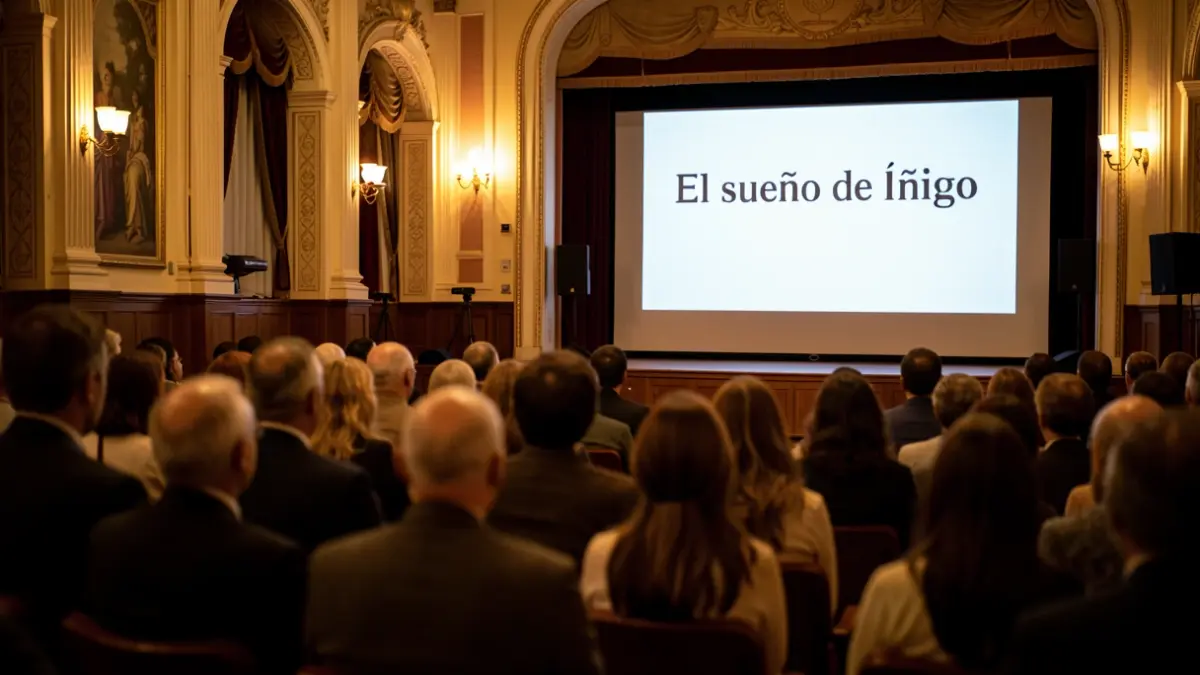
Almería hosted a special screening last Friday, June 5th, of Íñigo's Dream: An Imagined Script, a documentary that transcends cinema to address memory and justice. The film, directed by Nieves García Benito, mother of Íñigo Vallejo García, one of the rescuers who died in the Helimer 207 helicopter accident, serves as a tribute to emergency professionals and a denunciation of the systemic deficiencies that caused the tragedy.
The tragic event occurred on the night of January 21, 2010, when the Helimer 207 helicopter of SASEMAR, operated by INAER (currently Babcock MCS España), crashed into the sea near Almería airport. They were returning from night training maneuvers. The accident claimed the lives of commander José Luis López Alcalá, co-pilot Kevin Holmes, and rescue swimmer Íñigo Vallejo. Crane operator Alberto Elvira Vallejo was the sole survivor.
This accident became the most severe since SASEMAR's creation in 1992. The final technical report from the CIAIAC attributed the crash to a "controlled flight into water," influenced by visual illusions and instrument misinterpretations. However, the same report heavily criticized the operator INAER for significant deficiencies in training, the lack of appropriate checklists, and crew fatigue as contributing factors.
Director Nieves García Benito uses her film as a tool for moral reparation, aiming to restore dignity to the deceased pilots and their families. "One of my important objectives has also been to restore dignity to the pilot, José Luis López Alcalá, and the co-pilot, Kevin Holmes," she states, criticizing the tendency to blame human error while systemic structural shortcomings persist.
Benito describes the accident as "systemic," asserting that "the system does not work." She points out that despite the acquisition of high-end helicopters, the training provided by the private company was insufficient, leading to manual flight when the helicopter was equipped with autopilot. "There is a tremendous contradiction in culpability, because they say the pilots were to blame, but at the same time, it cannot be proven by an official report," she emphasizes.
The documentary sheds light on a prior written warning from an instructor pilot who alerted about inadequate preparation and flight safety issues, threatening to resign if remedies were not implemented. This confidential document reached Íñigo's father two years after the tragedy, fueling the fight against institutional inertia.
The families' judicial journey has been arduous. Following the initial dismissal of preliminary proceedings, the Prosecutor's Office requested the case be shelved. The director criticizes that the sole survivor and key witness, Alberto Elvira, was not initially called to testify by the judge. Subsequent attempts to reopen the case through unions and renowned law firms proved fruitless.
Íñigo's Dream, funded by personal savings and supported by the Asociación Tarínger, is the result of a titanic effort. The editing involved José Manuel Ulloa, Luis Alfonso Sena, and the invaluable collaboration of filmmaker José Manuel Mouriño.
The audiovisual narrative breaks traditional documentary molds, beginning with the director's shock upon hearing the news and transforming the tragedy into light through an "imagined script" that culminates in a real sea rescue. "A rescuer, when saving, embraces people; thus, 'Íñigo's Dream,' by recounting the moment of a rescue, extends its hands [...] and embraces the rescuer, returning them to life," reads the synopsis. It is, in the creator's words, "a mother's cry, but researched, truthful, not a sob story."
The vitality of Íñigo Vallejo, born in Seville in 1976 and shaped in Tarifa, underpins the narrative. His vocation as a rescuer was forged by the migratory crisis. He was passionate about triathlons and had recently become a father. Sadly, the survivor Alberto Elvira passed away in 2024.
The film transcends the specific case to become an essential tribute to all emergency operatives. "They help us live. It's tremendous, but it's true, if you fall in the middle of the street, the first thing you ask for is help, for a doctor or an ambulance. And no one remembers them until something like this happens," reflects Benito. She insists that specific Spanish regulations for SAR flights were not consolidated until 2014, four years after the Helimer crash.
Despite the judicial closure, the memory of the crew refuses to sink. In 2021, the Tarifa City Council inaugurated a service road named 'Íñigo Vallejo García. Maritime Rescuer'. On the twelfth anniversary of the accident, flower wreaths were cast into the waters where the tragedy occurred.
Nieves García Benito is not pursuing red carpets or industry acclaim but aims to foster real civic awareness about the precariousness hidden beneath rescue uniforms. "I have done what I could as a mother. My son's job was to be alert, protect, warn, rescue. So we must be alert, because these work accidents are paid for very dearly with death," she concludes with resolute fortitude. The screening in Almería thus serves as the embrace that history owed to its true protagonists, an inexhaustible effort to finally restore dignity to the eternal flight of Íñigo, José Luis, Kevin, and Alberto.