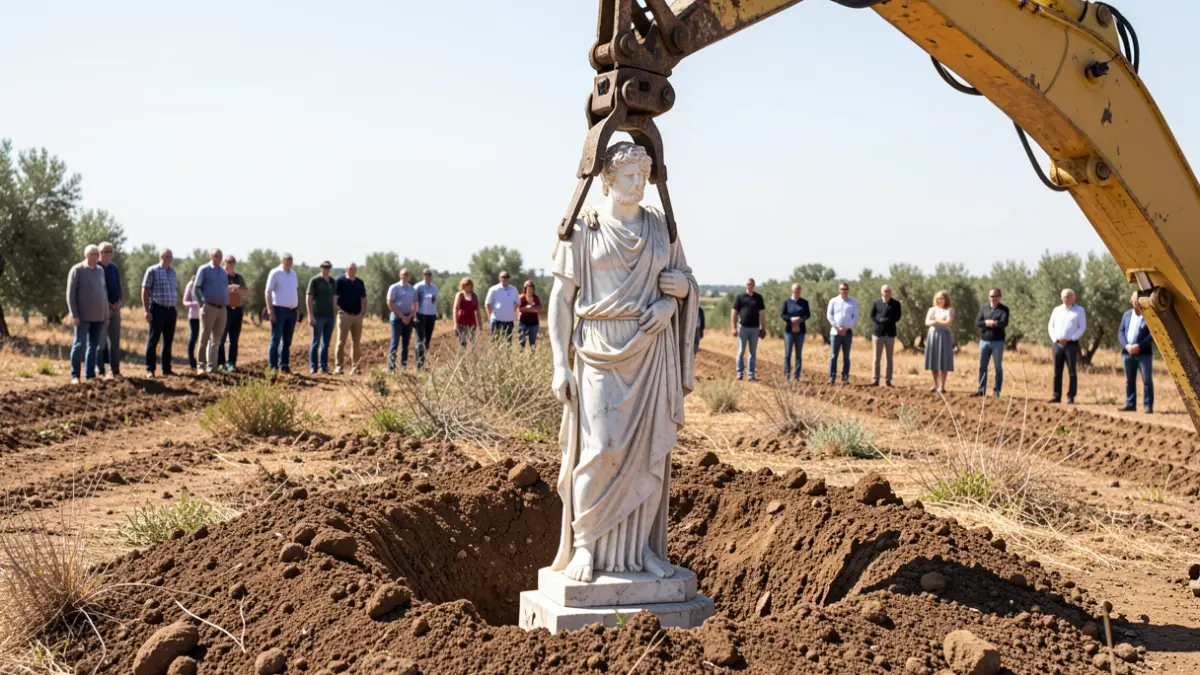
Heavy rainfall shifted the earth in the area of La Puebla de Cazalla, revealing a figure that two local residents correctly identified as a fragment of a sculpture. It turned out to be a marble Roman togate, 1.7 meters in height and weighing over 700 kilos, which has now become part of the holdings of the Seville Archaeological Museum.
The residents alerted the Territorial Delegation of Culture, which then informed the Seprona of the Guardia Civil to secure the piece on-site. The extraction was challenging due to the compact terrain and the statue's size, requiring mechanical means provided by the City Council. The piece was first temporarily moved to the local Local Police station before being transported, palletized, to the Museum's storage facility in San José de la Rinconada.
The figure is male, dressed in a toga and shoes, with the right leg flexed, giving it a sense of movement. At its feet is a cylindrical element. The back is flat and only partially carved at the lower section, indicating the sculpture was designed to be attached to a wall. Togate figures were common in Roman Baetica, adorning public spaces in cities and villas to display the local ruling class's status. This find joins others excavated in Baelo Claudia, Carteia, and Utrera.
Its chronology, however, remains open. No ceramic remains were found in the immediate vicinity to aid in dating, so the precise date and context will await scientific studies by the Museum. Conservators involved in the discovery, Marciala Mateos and Juan Antonio Pedrajas Pineda, hypothesize that due to its size, the togate might not be in its original location but was moved there from a nearby point to reinforce the ground, a relocation that would not be recent given how embedded it was in the compact soil.
The Minister of Culture, Patricia del Pozo, presented the piece during a visit to the Cultural Heritage Logistics Center, the external warehouse where the Archaeological Museum's collections are kept. Del Pozo highlighted the significance of the event not only for the sculpture itself but also for the residents' swift action in raising the alarm and the collaboration between the Regional Government and the City Council of La Puebla de Cazalla, which made the rescue possible.